The Hours Nobody Talks About: What Happens to a Scan Before Any Radiologist Opens It
A 3am scan can wait hours for an interpretation. Here's why the overnight coverage gap exists, what the workforce data shows, and how to close it.
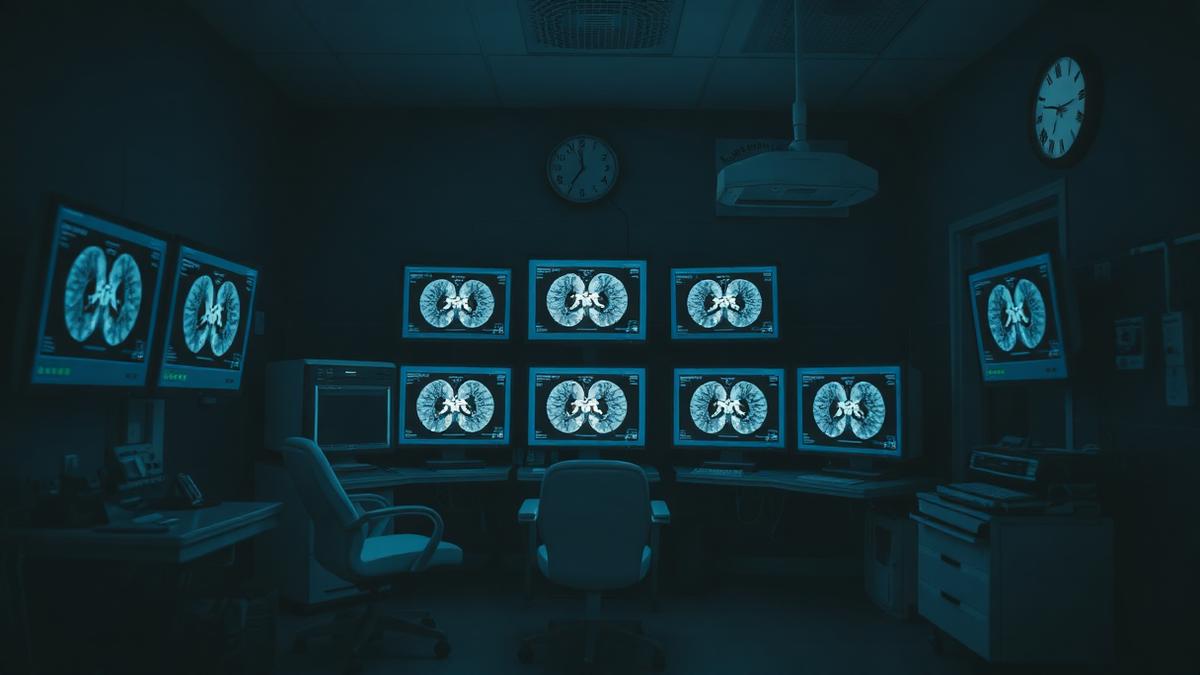
A head CT completes at 2:47am. The technologist confirms coverage and positioning, the study files to the archive, and then something happens that almost nobody in hospital leadership can describe precisely: nothing. Not to the patient — the emergency physician is already acting on the images and their own judgment. But no physician interpretation exists yet, and depending on how that facility is covered, none may exist for hours. 24/7 emergency nighthawk radiology is the category that grew up entirely inside that window, and the reason it exists has far less to do with technology than with a workforce arithmetic that has been quietly worsening for six years.
By Trisha Seal · August 27, 2026 · Written from RAD365's operational experience running offshore preliminary-read coverage for US human imaging facilities — preliminary interpretations only; final reads always remain with the facility's own licensed radiologist.
⚠️ Important scope note — please read before continuing
RAD365 provides offshore preliminary reads for human patients in the USA only — we do not provide final reads; your facility's own licensed radiologist completes every final interpretation. For veterinary and pet imaging there are no preliminary reads; veterinary studies are read as complete final reports by specialist veterinary radiology groups.
projected growth in US radiologist supply, 2023–2055 (Neiman HPI / JACR)
projected imaging utilization growth over the same period, by modality
higher rate of radiologists leaving the workforce since 2020 vs pre-COVID (Neiman HPI)
greater likelihood subspecialty radiologists exit the workforce (ACR Bulletin, Feb 2026)
The window that doesn't appear on any dashboard
Most imaging departments measure report turnaround from the point at which a radiologist begins reading. It is a reasonable operational metric and a genuinely misleading one, because it starts the clock after the interval that matters most. The period between study completion and the first physician interpretation is, in an uncovered facility overnight, frequently the longest single segment in the entire pathway — and it is the segment least likely to be reported to a board.
Closing that window is the entire purpose of an overnight preliminary reads layer, and it is worth being clear about what it does and does not change: nothing about acquisition, and nothing about who signs the final report.
What occupies that window is not idleness. The emergency physician has looked at the images. The technologist has flagged anything technically obvious. A disposition decision has been made and, in the overwhelming majority of cases, made correctly. The issue is that the decision is provisional in a specific sense: it has not yet been supported by a documented physician interpretation. For an unremarkable study that distinction is administrative. For the small proportion where something subtle is present, it is the difference between finding it at 3am and finding it at 9am — and those cases cannot be identified in advance, which is precisely why the window has to be covered as a whole rather than triaged.
Why the gap is structural, not a staffing hiccup
The temptation is to treat overnight coverage as a rota problem that a good recruitment year would solve. The published workforce research does not support that reading.
Research from the Harvey L. Neiman Health Policy Institute, published through JACR, projects US radiologist supply to grow 25.7% between 2023 and 2055, while imaging utilization over the same period is projected to grow between 16.9% and 26.9% depending on modality. At the top of that range, demand growth outstrips supply growth outright over three decades. Even at the lower end, the margin is thin enough that any regional imbalance — and radiologist distribution is markedly uneven — produces local shortfalls regardless of the national picture.
Attrition compounds it. The same Neiman HPI research finds radiologists have been leaving the workforce at a 50% higher rate since 2020 than pre-COVID trends would have predicted. And the departures are not evenly distributed across capability: per the ACR Bulletin (February 2026), citing Neiman HPI workforce data, subspecialty radiologists are 37% more likely to exit the workforce than generalists. Overnight emergency imaging is exactly where subspecialty depth is hardest to substitute, so the attrition pattern removes capacity from the part of the rota least able to absorb it.
Then there is the demand side, which is demographic and therefore predictable. Neiman HPI projects the population aged 85 to 94 to grow 149.6% by 2055, and the 95-plus cohort to grow 282.1%. These are the heaviest per-capita users of emergency and inpatient imaging, and they present disproportionately outside business hours. The overnight window is where the steepest demand curve meets the thinnest coverage.
Radiology pre-reads: the term the market actually searches for
There is a vocabulary split worth naming, because it shapes how departments find help. Formally, the deliverable is a preliminary interpretation. Conversationally — in reading rooms, in ED handovers, in the sentence an imaging manager types into a search bar at 11pm — it is a pre-read. The search demand behind that shorthand is substantially larger than the demand behind the formal term, which means a great deal of provider content is written in a language the buyer is not using.
The distinction between the terms is worth being precise about. A pre-read describes what is delivered: a documented physician interpretation issued ahead of the final signed report, to support an immediate clinical decision. Nighthawk describes when it is delivered: during overnight and out-of-hours windows. A department buying daytime overflow cover is buying pre-reads with no nighthawk element at all, and the deliverable is identical. Both sit inside the same service line — our preliminary reads coverage for human patients in the USA — and in both cases the facility's own licensed radiologist reviews the study and signs the final interpretation.
Why this matters practically: if you are evaluating providers and searching only in procurement language, you will surface a different and narrower set of results than if you search the way your department speaks. Try both.
What the covered window actually looks like, step by step
- Acquisition and technical QC. Unchanged, and running on the facility's existing human radiology operations stack. The technologist completes the study and confirms it is diagnostic. Nothing about the modality workflow is altered by adding coverage.
- Automatic routing. Rules defined by the facility evaluate modality, ordering location, order priority and time of day, and forward qualifying studies over the established secure connection. Relevant priors travel with the study.
- Reading and preliminary interpretation. The study surfaces on the covering radiologist's worklist ordered by urgency and is interpreted. The preliminary report returns into the facility's existing worklist and record, clearly labeled as preliminary.
- Critical-finding escalation. If the study contains anything on the facility's defined critical list, the named on-shift provider is contacted directly by the agreed method, receipt is verbally confirmed, and a time-stamped entry records who was contacted, when and what was communicated.
- Final interpretation. The facility's own licensed radiologist reviews the study independently on the normal reporting schedule and signs the final report, which becomes the interpretation of record and supersedes the preliminary.
The coverage models, and what each leaves uncovered
| Dimension | In-house overnight rota | Local on-call from home | Dedicated 24/7 preliminary coverage |
|---|---|---|---|
| Who is reading at 4am | A daytime radiologist mid-rotation | Whoever is woken | A radiologist working their normal shift |
| Time to first interpretation | Short when staffed | Variable — includes wake and log-in time | Contracted by priority tier, measured |
| Holiday and leave resilience | Weakest point of the model | Depends on one or two individuals | Absorbed by the rota, not the facility |
| Effect on daytime capacity | Reduces it — post-night recovery | Reduces it unpredictably | Neutral; daytime rota untouched |
| Multi-site scalability | Poor below a volume threshold | Poor — per-site individuals needed | Strong — one rota, per-site routing |
| Who signs the final report | Facility radiologist | Facility radiologist | Facility radiologist — always |
| Audit trail of the overnight decision | Usually present | Often informal | Time-stamped by design |
The final row of that table is the one that is easiest to overlook and hardest to reconstruct after the fact. An overnight phone conversation that was never logged is, from a compliance standpoint, a conversation that cannot be evidenced. Structured escalation logging is one of the underrated benefits of a formalised coverage layer, and it feeds directly into the discrepancy sampling that belongs in any department's peer review and QA cycle.
What good looks like six months in
Coverage is easy to buy and harder to verify. Four measures, read together, tell you whether it is working: percentile turnaround segmented by hour of day and priority tier, not a blended mean; the measured actionable discrepancy rate between preliminary and final interpretations, with a defined methodology behind it; escalation compliance, meaning every critical finding contacted and logged within protocol; and the change in your own radiologists' overnight call burden. That last one is the honest test. If turnaround looks excellent but nobody's nights got quieter, the routing rules are too narrow and the coverage is solving a smaller problem than the one you bought it for.
24/7 nighthawk coverage and radiology pre-reads: frequently asked questions
How 24/7 nighthawk coverage actually works
What does "24/7 emergency nighthawk radiology" actually mean in operational terms?
It means a physician is available to interpret an emergency study at any hour, on any calendar day, without the study having to wait for a local radiologist to wake up or come back on shift. Operationally that requires three things running continuously rather than on request: a staffed reading rota that never has an unassigned hour, a routing path that delivers qualifying studies to that rota automatically, and a named escalation contact on the facility side who can be reached for a critical finding at 3am. Coverage that depends on someone answering a phone before the reading starts is not 24/7 coverage — it is on-call arrangement with extra steps.
What happens to a scan in the hours before any radiologist opens it?
In an uncovered overnight window, more than most people assume. The study is acquired, quality-checked by the technologist and filed to the archive, where it sits in a queue behind whatever else arrived that night. The ordering clinician makes an immediate disposition decision from the technologist's technical impression, their own read of the images, and clinical judgment. If the patient is admitted or held for observation, that decision is provisional until an interpretation exists. The gap is rarely dramatic — most studies are unremarkable — but the cost of the gap is concentrated in the small share that are not, and those cannot be identified in advance.
How do overnight shift patterns differ between an in-house rota and a dedicated nighthawk rota?
An in-house overnight rota is usually a rotation: the same radiologists who read daytime volume take turns covering nights, which means the person reading at 4am is often mid-way through a disrupted circadian pattern and is back on daytime duty within days. A dedicated nighthawk rota is staffed by physicians whose working day is that shift in their own time zone, so the coverage window is a normal working period rather than an endurance exercise. The practical consequences are steadier turnaround through the small hours and no dependency on any single individual's availability for holiday, illness or leave.
Can nighthawk-style coverage extend across multiple facilities or sites in one network?
Yes, and multi-site is usually where the economics change decisively. A single 30-bed critical access hospital rarely generates enough overnight volume to justify a dedicated in-house night radiologist, but four such sites in a network collectively do generate enough to make a shared covered rota straightforward. The requirements are per-site routing rules, per-site escalation contacts and protocols, and reporting broken out by facility so each site can see its own turnaround rather than a network average that hides an outlier.
How is holiday and weekend coverage staffed differently from ordinary weeknights?
It should not be staffed differently at all, and that is the point worth verifying in a contract. Public holidays and long weekends are precisely when in-house rotas thin out and when emergency imaging volume does not. Ask a prospective coverage partner a specific question: what was your measured turnaround on the last three public holidays, and how many readers were rostered compared with a normal Tuesday night? A partner running genuinely continuous coverage will have that data. A partner running best-effort coverage will describe intentions instead.
Radiology pre-reads: the term buyers actually search
What are radiology pre-reads, and are they the same thing as nighthawk coverage?
"Radiology pre-reads" describes the deliverable; "nighthawk" describes when it is delivered. A pre-read is a documented preliminary interpretation issued before the final signed report exists, to support an immediate clinical decision. Nighthawk coverage is the staffing model that produces pre-reads during overnight and out-of-hours windows. A department can buy pre-reads for daytime overflow without any overnight element, and the deliverable is identical — the difference is the shift the reader is working. Both sit within our preliminary reads service line for human patients in the USA.
Why do buyers search for "pre-reads" rather than the formal terminology?
Because it is the language of the department rather than the language of the contract. Radiologists, ED physicians and imaging managers say "pre-read" conversationally; procurement documents say "preliminary interpretation services." The search-demand split matters practically for anyone evaluating providers: a provider's website may be written entirely in procurement language while the person doing the research is searching in clinical shorthand, which means genuinely capable partners can be hard to surface. If you are searching, try both vocabularies.
Do pre-reads change anything about how the ordering clinician documents their decision?
The clinician still documents their own clinical reasoning and disposition, as they always have. What changes is that the note can reference a documented physician interpretation rather than resting on the images plus judgment alone. The pre-read enters the record as a clearly labeled preliminary interpretation, distinct from the final report, and the final signed interpretation from the facility's own radiologist supersedes it as the interpretation of record. Nothing about the clinician's own documentation obligation is transferred or reduced.
Is there a quality difference between a daytime overflow pre-read and an overnight one?
There should be none, and the way to confirm it is to ask for turnaround and discrepancy data segmented by hour of day rather than as a single blended figure. A blended average can conceal a rota that is well staffed at 9pm and thin at 4am. Segmented reporting exposes that immediately. Systematic sampling of both windows also belongs in the department's ongoing peer review and QA program rather than being left to the provider to self-assess.
The workforce numbers behind the coverage gap
Is the radiologist shortage actually getting worse, or has it stabilised?
The published projections point to a structural gap rather than a cyclical one. Research from the Harvey L. Neiman Health Policy Institute, published through JACR, projects US radiologist supply to grow only 25.7% between 2023 and 2055 while imaging utilization grows 16.9% to 26.9% depending on modality — meaning the upper end of demand growth outpaces supply growth over a three-decade horizon. That is not a staffing wobble that resolves with one strong residency intake; it is a persistent mismatch that departments have to design around.
Are radiologists leaving the profession faster than they used to?
Yes. The same Neiman HPI research finds radiologists have left the workforce at a 50% higher rate since 2020 compared with pre-COVID trends. Attrition of that magnitude compounds: each departure raises the reading burden on those who remain, which is itself a documented driver of further attrition. For a department, the practical implication is that overnight coverage built entirely on the willingness of existing staff to absorb extra shifts is resting on the least stable part of the workforce picture.
Which radiologists are most likely to leave, and why does that matter for overnight cover?
Per the ACR Bulletin (February 2026), citing Neiman HPI workforce data, subspecialty radiologists are 37% more likely to exit the workforce than generalists. That matters disproportionately for out-of-hours coverage because subspecialty depth is what a department leans on for the hardest overnight cases — the neuro, the complex vascular, the paediatric study at 2am. Losing generalist capacity thins the rota; losing subspecialty capacity thins the rota's ceiling.
What is driving imaging volume growth over the next few decades?
Demographics more than anything else. Neiman HPI projects the population aged 85 to 94 to grow 149.6% and the 95-plus population to grow 282.1% by 2055. Those cohorts are the heaviest per-capita users of emergency and inpatient imaging, and they present disproportionately outside business hours. So the demand curve is not just rising — it is rising fastest in exactly the population and the time windows where overnight coverage is already thinnest.
Does adding preliminary coverage reduce the number of radiologists a department needs?
No, and any provider suggesting it does is overselling. The facility's own licensed radiologists still review and sign every final interpretation, so the final-read workload does not disappear. What changes is when that work has to happen and under what pressure. A preliminary layer removes the requirement for a local radiologist to be awake and reading at 3am to support an immediate decision, letting the final reporting cycle run on a sustainable schedule. It is a redistribution of when the work occurs, not a reduction in how much of it there is.
Evaluating and running 24/7 coverage
What is the single most revealing question to ask a 24/7 coverage provider?
Ask what happened during their worst hour last quarter. A provider that measures itself properly can tell you the hour with the longest turnaround, why it happened, and what changed as a result — a volume surge, a transfer fault, a rota gap. A provider that only quotes averages either does not measure at that resolution or would rather not discuss it. Averages describe normal operation; you are buying coverage for the abnormal.
How should turnaround time be measured so the number means something?
Define where the clock starts and stops before signing anything. A target measured from when the study lands on the reading worklist behaves very differently from one measured from acquisition completion, because everything between those two points — transfer, routing, prior retrieval — is excluded from the first and included in the second. Insist on acquisition-to-preliminary-report as at least one reported metric, reported at percentiles rather than as a mean, since the tail is where clinical risk concentrates.
What has to be in place before overnight coverage can go live?
Four things, and all four are usually achievable within a few weeks. A secure connection between the facility's archive and the reading environment, with the network and firewall path tested under load rather than just pinged. Routing rules defining exactly which studies leave and when. A written critical-findings escalation protocol naming the on-shift contact for every hour of the week. And a documented prelim-to-final workflow so the audit trail is unambiguous from day one. None of this requires replacing existing systems — integration runs against the imaging infrastructure already in place.
How do you know after six months whether the coverage is actually working?
Look at four measures together rather than any one alone: percentile turnaround segmented by hour and priority tier; the measured actionable discrepancy rate between preliminary and final interpretations; escalation compliance, meaning every critical finding contacted and logged within protocol; and, on the human side, whether your own radiologists' overnight call burden has actually dropped. If turnaround is excellent but the call burden is unchanged, the coverage is running but the routing rules are too narrow to have relieved anything.
Related reading
- Preliminary reads for US human imaging facilities — full service scope
- How overnight and overflow prelim coverage is contracted and measured
- Human radiology operations and support services
- Peer review and QA programs for imaging departments
- The PACS layer that overnight routing depends on
Want to see what your overnight window actually costs you?
Send us your out-of-hours volume by modality and your current coverage arrangement. We'll map where the uncovered hours sit and what closing them would involve — preliminary reads only, with your radiologists signing every final report.
Talk to our coverage team →