The Year a 200-Bed Hospital Network Fixed Its PACS: A Managed PACS Story
A composite hospital case study on managed PACS: the breaking point, what failed first, and what day-to-day managed PACS support actually changed.
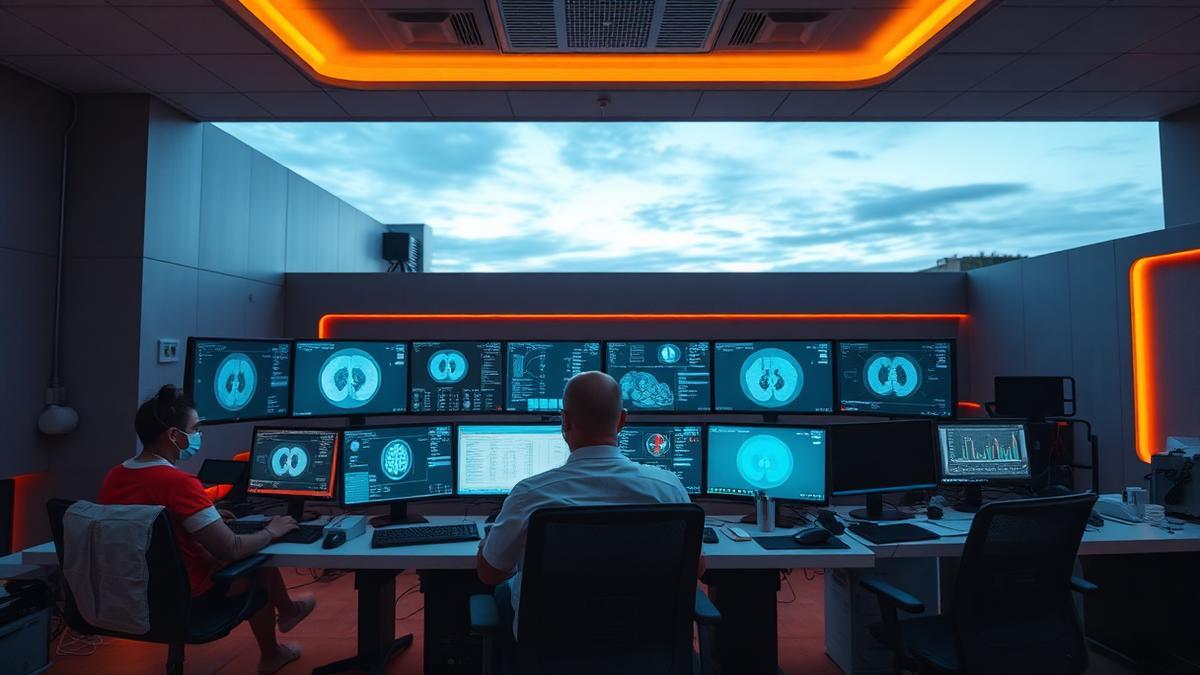
The imaging director of an illustrative regional 200+ bed hospital network — a composite of situations we see repeatedly, not a named customer — spent a Tuesday morning in March watching a worklist that would not populate. By the time the archive came back, four hours had gone, two CT slots had been rebooked and the on-call radiologist had read six studies off a modality console. That morning is why the network went looking for managed PACS support, and this is what the following twelve months actually looked like.
global medical imaging PACS market, 2025 to 2026 (2026 medical imaging PACS market report, Research and Markets)
CAGR for the PACS market into 2026, per the same report
share of the 2026 PACS market held by hospitals, driven by imaging volume and infrastructure complexity
projected CAGR for the broader PACS and RIS category through the mid-2030s (industry market research aggregators)
The breaking point
Nothing about the March outage was exotic. A storage tier had been filling for weeks, the alerting that would have flagged it had been muted during an unrelated project the previous autumn, and the one person who understood the routing configuration was on leave. Three ordinary conditions intersected and the department stopped.
What made it a turning point was the second incident, eleven days later, with a different cause and the same shape: an interface fault after a modality firmware update, no monitoring on the message flow, and a four-hour diagnosis because nobody on site could read the HL7 traffic. Two unrelated faults, one common factor — the network had imaging systems but no imaging operations.
Why this scenario keeps getting more common
The context is not incidental. A 2026 medical imaging PACS market report from Research and Markets puts the global PACS market at $4.43 billion in 2025, growing to $4.83 billion in 2026 — a 9.1% compound annual growth rate — with hospitals accounting for roughly 60% of that market in 2026 precisely because of their imaging volume and infrastructure complexity. Industry market research aggregators tracking the wider PACS and RIS category project it growing at around 8.7% CAGR through the mid-2030s.
Those figures describe estates getting larger, more interconnected and more clinically load-bearing every year. Enterprise viewers, VNAs, AI triage tools, cross-site sharing and EHR integration each add a failure domain. Support models, meanwhile, tend not to grow at 9% a year — they stay as they were when PACS meant one server and one viewer. That gap is the whole story, and it is the reason a structured managed PACS service exists as a category rather than as a line item in general IT.
What they tried first
The network's first response was the reasonable one: hire. A second PACS administrator was approved, and recruitment ran for five months without a suitable appointment. In the meantime the department bought an incident-based support block from a break-fix provider at an hourly rate.
It did not work, for a structurally boring reason. Break-fix pays for attendance at failures, so nobody was paid to prevent them. Storage thresholds stayed unmonitored, no root-cause analysis was produced after any incident, and by August the network had spent a meaningful sum on emergency hours while the underlying conditions were exactly as they had been in March. Meanwhile the PACS vendor announced end-of-support dates for the version in production, converting a maintenance problem into a migration problem.
In-house vs. break-fix vs. managed PACS support
| Dimension | In-house only | Break-fix vendor | Managed PACS support |
|---|---|---|---|
| Coverage | Business hours, one or two people | On request, callback window | 24/7 monitored, named escalation |
| Prevention | Intent, no capacity | Unbillable, so absent | Contracted and reported |
| Cost profile | Fixed salary, hidden overtime | Unpredictable, spikes with failure | Flat fee, budgetable |
| Continuity risk | High — single person | High — no ownership | Low — documented, multi-engineer |
| Interface depth | Variable | Usually escalated out | Core competency |
| Accountability | Effort-based | Time and materials | Written SLAs with remedies |
What the managed engagement actually looked like
The first thirty days produced no heroics and a great deal of documentation. Every DICOM node, AE title, routing rule, interface mapping and storage tier was inventoried, and the resulting document was the first complete picture of the estate the network had ever held. Monitoring was then instrumented against real traffic patterns — queue depth, send failures, storage headroom, interface acknowledgements, modality worklist response times — rather than vendor defaults.
Day-to-day, the shape was unglamorous and consistent: overnight alerts triaged before the day shift arrived; user, worklist and hanging-protocol administration handled as routine work rather than as favours; monthly patching against a tested rollback; a written root-cause analysis after every P1; and vendor escalation carried by the support team instead of by the imaging director. The legacy version nearing end of support was stabilised and isolated while a costed replacement path was prepared in parallel — the approach described on the PACS migration services page, where the old archive stays authoritative until reconciliation is signed off.
Two operational details did most of the work. First, coverage of the interface layer: once HL7 and DICOM message flow was monitored directly, the category of fault that had taken four hours in March was being detected and fixed before radiology noticed. Second, the escalation path was named — a person, not a queue. During the September migration weekend the network also ran a short block of interim PACS support to cover the parallel-run period without pulling its own administrator onto nights.
Stat callout
Hospitals hold roughly 60% of the 2026 PACS market — a share driven, per the 2026 medical imaging PACS market report, by exactly the two variables that break support models: imaging volume and infrastructure complexity. Growth of 9.1% a year in the underlying estate is growth in the number of things that can fail at 3am.
The resolution
By the following March the network's imaging incidents had changed character rather than simply falling in number. The residual incidents were shorter, they were detected by monitoring rather than reported by a technologist, and each one produced a document explaining why it happened. The migration off the end-of-life version completed over a scheduled weekend with a reconciled study count and no clinical downtime on the Monday.
The imaging director's own summary was less about uptime than about attention: she stopped being the escalation path. The broader operational picture — service desk, imaging network, modality connectivity — is set out on the radiology IT support page, and the coverage model itself on managed PACS services.
Lessons other hospitals can take from it
- Count your incidents before you shop. Twelve months of imaging incidents, with duration and clinical impact, gives you the denominator every proposal has to be measured against.
- Buy prevention, not attendance. Any commercial model that pays a provider more when you fail more will not produce proactive work, however competent the engineers are.
- Monitor the interfaces, not just the servers. The servers are usually up during the outage that stops the department.
- Treat a single administrator as a single point of failure. Not a criticism of the person — an accurate description of the risk.
- Handle end-of-life on your timeline. Stabilise, document, plan and migrate deliberately; a vendor sunset only becomes an emergency when you let it set the date.
About the author
Trisha Seal writes on radiology operations and imaging IT for RAD365. RAD365 is a physician-owned operations partner providing managed and outsourced PACS support — 24/7 imaging engineers, vendor-agnostic coverage across mixed estates, and a flat-fee model with written SLAs. RAD365's scope on this page is systems, infrastructure and PACS operations support.
Put a support model behind your PACS
Talk to a RAD365 PACS engineer about 24/7 coverage, migration planning or interim support for your imaging estate.
Talk to a PACS engineer →Managed PACS support: frequently asked questions
Managed PACS: Scope and Definitions
What is a managed PACS support company, and how is it different from in-house IT?
A managed PACS support company takes contractual ownership of the operational health of your imaging systems — the archive, the diagnostic and enterprise viewers, DICOM routing, modality worklist services and the interfaces that connect them to the RIS and EHR. In-house IT usually owns the whole hospital estate, of which imaging is one application among hundreds, and PACS expertise sits with one or two individuals. The practical difference is depth and continuity: a managed provider staffs imaging specialists around the clock, works to written response and restoration targets, and does not lose its institutional knowledge when a single administrator resigns.
What do PACS support services actually include for a radiology department?
Proactive monitoring of archive, storage, routing and interface layers; incident response under named priority classes; day-to-day PACS administration such as user accounts, worklists, hanging protocols and modality configuration; DICOM and HL7 troubleshooting; patching, version upgrades and capacity planning; escalation to the PACS vendor on your behalf; and documented monthly reporting on uptime, incident volume and root causes. If a contract schedule labels any of that 'best efforts', treat it as uncovered.
What's the difference between L1 and L2 PACS support tiers?
L1 is the front line: triage, known-fault resolution from runbooks, user and worklist administration, restart and re-send procedures, and correct classification of the incident. L2 is the engineering tier: interface and DICOM analysis, database and storage work, configuration changes, root-cause investigation and vendor escalation. What matters is not the labels but the handover — how quickly L1 recognizes that a fault belongs to L2, and whether L1 speaks imaging rather than image access from a generic service-desk script.
Does managed PACS support include DICOM and HL7 interface troubleshooting?
It should, and it is the single most useful thing to confirm before signing. A large share of calls logged as 'PACS is down' are interface faults: an order that never arrived, a study that will not reconcile against the accession number, a modality worklist query failing after a firmware update, a routing rule quietly dropping a series. Support that can read the message traffic resolves those within the hour. Support that cannot will open a vendor ticket and wait.
Can managed PACS support work across multiple modalities and vendors?
Yes, and mixed estates are the normal case rather than the exception — especially after acquisitions, where one site's archive, another's RIS and a third's viewer all have to coexist. Competent multi-vendor support rests on standards fluency (DICOM conformance statements, HL7 message profiles, IHE workflow profiles) plus demonstrated hands-on time with your specific platforms and versions. Ask for the second part explicitly; standards knowledge alone does not fix a vendor-specific database quirk at 3am.
Downtime, SLAs and Response
How do PACS support services reduce downtime in imaging workflows?
In two ways, and the first matters more. Most imaging outages announce themselves before they land — queue depth climbing, failed sends accumulating, storage pressure, an interface that has stopped acknowledging. Monitoring tuned to your environment converts those precursors into tickets while radiology is still image access normally. The second is restoration speed: a documented runbook, a named escalation path and an engineer who has seen the fault before turn a three-hour event into a forty-minute one.
What SLAs should a managed PACS provider guarantee for uptime and response time?
Look for a stated uptime commitment on the production archive and viewer, response targets by priority class, restoration targets (not just response), and — most importantly — the measurement rules. Ask whether response is measured from the alert or from a human phoning in, whether performance is reported at the mean or at the 95th percentile, and what the remedy is when targets are missed. An SLA with no measurement definition is marketing.
How fast should a managed PACS provider respond to a critical (P1) outage?
For a P1 — imaging stopped or diagnostic image access blocked — a live engineer should be engaged within minutes, not within a business-hours window, with continuous updates on a fixed cadence until service is restored and a written root-cause analysis afterwards. The number in the contract matters less than what happens behind it: whether the responder can make configuration changes without waiting for a change board, and whether they can escalate to the vendor with an existing support relationship rather than starting a new one.
Which qualities separate genuine 24/7 monitoring and incident response from a basic support arrangement?
Genuine 24/7 means an engineer already awake and already looking at your systems, with alert thresholds tuned to your normal traffic patterns rather than defaults. Basic arrangements offer an out-of-hours number that reaches a rota, a callback window, and a first responder who has to be briefed on your environment before they can start. The tell is what the provider knows before you call — a real monitoring service usually calls you.
What happens during a PACS migration under a managed support model?
The old environment stays authoritative until the new one is validated. Studies are moved in reconciled batches with counts, series integrity and identity mapping verified at each stage; a rollback point is defined before anything moves; and clinical cutover is scheduled around real image access patterns rather than IT convenience. The risk in migrations is rarely transfer failure — it is silent loss: missing series, broken accession links, prior studies that no longer hang alongside the current one. Reconciliation reporting is what protects against that.
Cost and Commercial Model
How much does managed PACS support typically cost for a mid-sized hospital or imaging center?
Pricing is driven by study volume, number of sites and modalities, the complexity of the interface estate, the age of the PACS and the coverage window — a single-site imaging center with one modern archive and a fully managed multi-site network with a legacy component sit far apart. Rather than shopping for a number, build your own denominator first: twelve months of imaging incidents, their duration, and the clinical impact of each. That figure is what any proposal has to be measured against, and it makes the finance conversation straightforward.
How does a flat-fee managed model compare with hourly break-fix support?
They create opposite incentives. Under break-fix, the provider's revenue rises with the number and length of incidents, and prevention work is unbillable, so it does not happen. Under a flat fee, every hour the provider spends preventing an outage protects their own margin, which is why proactive monitoring and root-cause analysis appear in flat-fee contracts and rarely in hourly ones. Break-fix also produces unpredictable spend precisely in the months you can least afford it.
What are the real benefits of outsourcing PACS management versus keeping it in-house?
Continuous coverage without hiring a night shift; multiple specialisms instead of one person's skill set; continuity when your administrator leaves; and contractual accountability where previously there was only effort. The trade-off is that an external team has to be deliberately taught your workflows. Most hospitals get the best result from a co-managed arrangement — the internal administrator keeps the clinical relationship and change ownership, while the managed service carries out-of-hours cover, escalation depth and documentation.
How does managed PACS support handle legacy or end-of-life PACS systems?
By stabilising the system and buying a decision window rather than forcing an emergency replacement. That means documenting the environment properly, isolating and hardening unsupported components, establishing the real failure modes, maintaining a tested recovery path, and developing a costed migration option in parallel. A deprecated PACS is a risk to be managed on a timeline; it becomes a crisis only when the timeline is set by a failure instead of by the hospital.
Choosing and Evaluating a Provider
What should a hospital look for when choosing a PACS support service?
Imaging-specific engineering depth rather than general infrastructure skills; written response and restoration targets with stated measurement rules; a real monthly report you can inspect before signing; a defined vendor-escalation route; documented change control and access management; and a clean, contractual offboarding process. The last one is revealing — a provider that is uncomfortable describing how you would leave is relying on switching friction rather than performance.
How should a hospital evaluate a managed PACS support company before signing a contract?
Run a structured evaluation rather than a demo. Ask them to walk through a recent P1 at a comparable site end to end, including what went wrong in their own handling. Ask who answers at 3am on a Sunday and what their imaging background is. Ask to see an anonymised root-cause report. Ask how they would take over your environment in the first 30 days, and what they would need from you. Ask a reference customer specifically about escalation, not about friendliness.
How does vendor-agnostic PACS support work across GE, Siemens, Philips and other platforms?
Vendor-agnostic support is anchored in the standards layer that all those platforms share — DICOM services, HL7 or FHIR messaging, IHE workflow profiles, storage and network behavior — and supplemented with platform-specific operational knowledge for the products actually in your estate. In practice it means the provider can diagnose a fault at the protocol level, tell you whether it belongs to the product vendor, and manage that escalation rather than handing you a ticket number. It does not mean they are equally expert in every product ever shipped; ask which ones they run today.
What red flags suggest a hospital has outgrown its current PACS support model?
Repeat incidents with no root-cause analysis; tickets closed rather than resolved; escalation that depends on knowing someone's mobile number; reports that describe activity instead of outcomes; nobody who can explain your interface layer; upgrade advice that always points at the provider's preferred product; and radiologists routing around the system with workarounds they have stopped reporting. Any two of those together usually mean the arrangement stopped scaling some time ago.
