Outsourced Veterinary PACS Support: The Data Behind Why Practices Are Handing It Over
Imaging volume is growing faster than veterinary staffing. The market and workforce data behind why practices are outsourcing PACS support in 2026.
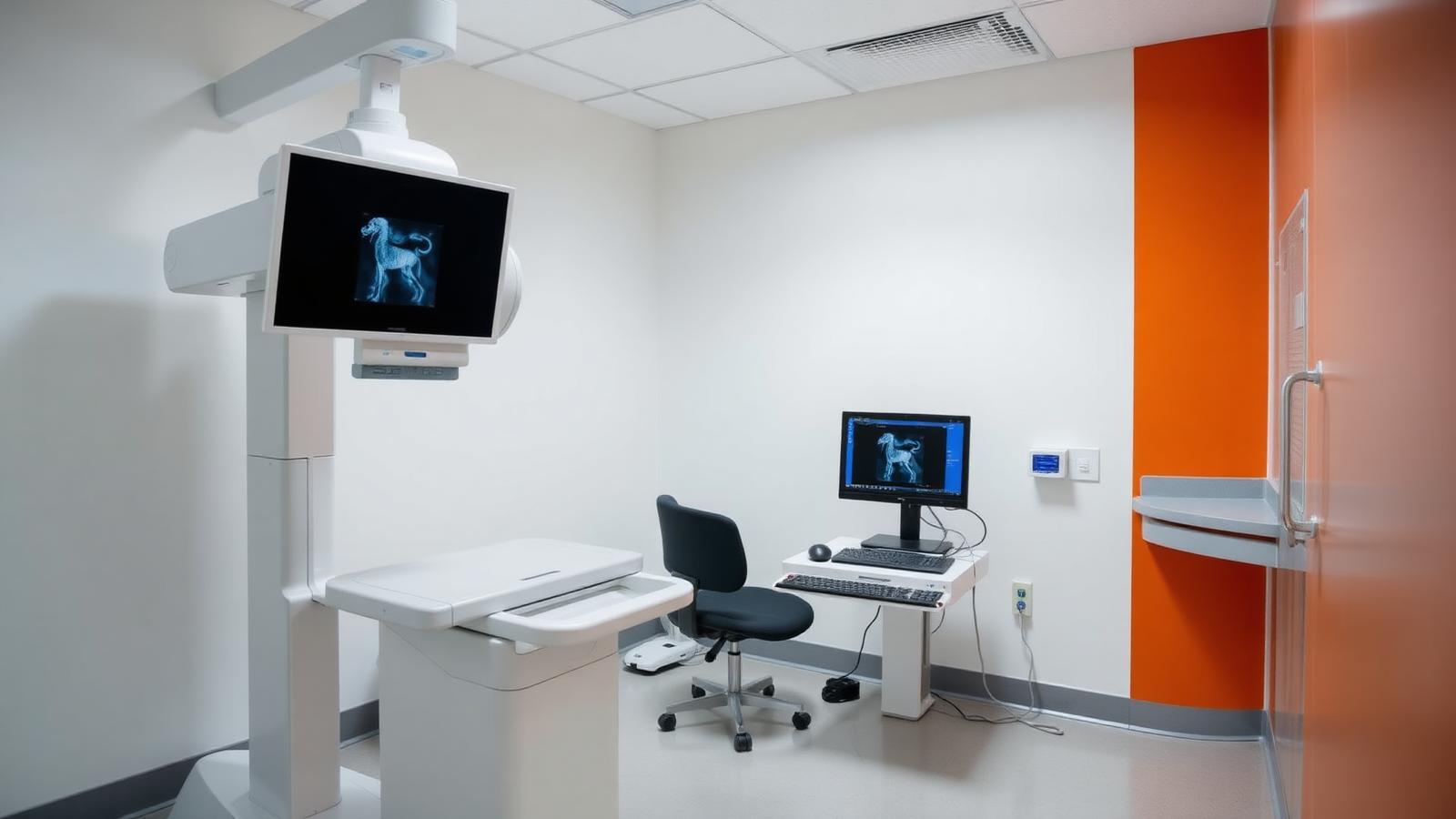
Outsourced veterinary PACS support has moved from a large-group luxury to an ordinary operational decision, and the reason is arithmetic rather than fashion. Veterinary imaging volume is growing steadily while the staffing available to manage it is not, so the informal arrangement that worked at one site with one modality stops working somewhere around the second scanner and the second location. This is a look at the numbers behind that shift, and what changes when the imaging chain gets a dedicated owner — the service itself is described under veterinary PACS support.
veterinary imaging market, 2025 to 2026 (~7.7% growth; GlobeNewswire)
projected market size by 2030–2031 (MarketsandMarkets)
board-certified veterinary radiologists in the entire USA, 31 Dec 2024 (AVMA)
veterinary job openings in 2023, up 22% from 2021 (AVMA)
The growth curve is real and it is not slowing
GlobeNewswire's veterinary diagnostic imaging market report puts the market at $2.37 billion in 2025, rising to $2.55 billion in 2026 — roughly 7.7% growth in a single year — and MarketsandMarkets' veterinary imaging market report projects continued expansion toward approximately $3.3 to $3.4 billion by 2030–2031.
Market size is an abstraction, but the way practices experience it is not. It arrives as more studies per day, larger archives with longer retention expectations, more modalities per site, and more referral traffic moving images between organizations. Every one of those is a support load, and none of them reduces the following year.
The workforce curve is going the other way
AVMA workforce data records just 667 board-certified veterinary radiologists in the entire United States as of 31 December 2024. That is the specialist pool serving every practice, referral hospital and university in the country. Separately, the AVMA reported 19,500 veterinary job openings in 2023, a 22% increase over 2021.
Those two figures describe different problems, but they compound in the same direction. When clinical roles are hard to fill, the informal capacity that used to absorb imaging IT work — the associate who was good with computers, the practice manager who learned the archive — disappears first, because that person's clinical hours are needed elsewhere. Growing imaging volume meets shrinking discretionary time.
Where in-house management actually breaks
It rarely breaks with an outage. It breaks quietly, in five recognisable places:
- Backups nobody verifies. The archive backs up nightly and no one has attempted a restore in two years. This is the most common and most consequential gap we find.
- Identifier drift across modalities. Each device handles animal name, owner surname and species slightly differently, producing duplicate and orphaned studies that only surface when a prior cannot be found.
- The second site. Consolidation means studies acquired at one clinic must be visible at another, and separate archives with separate conventions do not reconcile themselves. The fault lives in the seams. Estate-wide coverage is what veterinary IT support is for.
- Practice management integration decay. A PIMS upgrade quietly changes an interface and images stop attaching to records; staff start re-keying, and nobody reports it because there is a workaround.
- After-hours dependence on one person. Emergency and referral caseloads peak precisely when the informal owner is off. One resignation and the institutional knowledge leaves with them.
None of these is a crisis on the day it starts. All of them are expensive by the time they are noticed, which is why the practices that handle this well move before the failure rather than after it. Routing and connectivity, in particular, are worth giving an explicit owner — that layer is handled by a veterinary DICOM gateway.
| Responsibility | In-house / informal | Outsourced PACS support |
|---|---|---|
| Monitoring | Reactive — staff report problems | Continuous, with defined alert thresholds |
| Backup and restore | Backups exist; restores untested | Verified restore testing on a stated schedule |
| DICOM / modality faults | Manufacturer support, per device | One owner across all brands |
| PIMS integration | Set up once, rarely revisited | Tested after every upgrade |
| After hours | One person's phone | Rota with escalation and SLA |
| Adding a site or modality | Disruptive project | Routine onboarding |
What a sensible transition looks like
- Inventory the estate. Every modality, archive, viewer, PIMS version and site — including the dental unit and the ultrasound nobody remembers configuring.
- Baseline ninety days. Imaging-related interruptions, time spent by clinical staff resolving them, and studies that had to be repeated or chased.
- Verify a restore. Before anything else changes, prove the archive can actually be recovered. If it cannot, that is the first project.
- Fix identifiers and routing. Standardize how patients are identified across modalities, then make routing rules explicit rather than incidental.
- Define coverage and SLAs. Severity by clinical impact, response and resolution commitments including weekends, named escalation, monthly measured reporting.
- Review at ninety days against the baseline you took at step two.
Groups running this sequence usually find the biggest win is not uptime but recovered clinical hours. Workflow consistency across sites is the second, and that is where veterinary workflow management and disciplined veterinary peer review and QA reinforce each other. The full systems scope, including multi-site estates, sits on the veterinary PACS support page.
The strategic reason, not just the operational one
Given the growth trajectory in the market data and the hard ceiling on specialist availability, the practices best positioned for the next five years are the ones whose imaging infrastructure can absorb volume without a proportional increase in internal effort. That is what handing the imaging chain to a dedicated owner buys: not merely fewer bad Saturdays, but the ability to add a site, a modality or a referral relationship without it becoming a project. Practices comparing options across the wider category often start with the veterinary radiology overview and narrow from there.
Find out where your imaging estate is exposed
Send us your modality list, PIMS version and site count. We will point out the specific gaps — starting with whether your archive can actually be restored.
Request an estate review →Outsourced Veterinary PACS Support: Frequently Asked Questions
Why Vet Practices Need Outsourced PACS Support
Why are veterinary practices increasingly outsourcing PACS management instead of handling it in-house?
Because imaging volume and system complexity have grown faster than practice staffing. A decade ago a single digital radiography unit and a local archive could be looked after by whoever in the building was most comfortable with computers. Today a mid-sized practice may run DR, CT, ultrasound and dental imaging, integrated with a practice management system and shared across sites. That estate needs monitoring, backups, DICOM configuration and after-hours response — which is a job description, not a favour someone does between appointments.
How does multi-site consolidation change PACS support needs for veterinary groups?
Consolidation turns several independent imaging setups into one estate that has to behave consistently. Studies acquired at one clinic must be visible at another, patient and owner identifiers have to reconcile across previously separate systems, and equipment from different manufacturers has to talk to a shared archive. The failures land at the seams between sites rather than inside any one clinic, which is exactly the class of problem a single-site IT arrangement is not built to see, let alone fix.
What imaging volume growth are veterinary practices actually seeing?
The market data tracks it clearly. Veterinary diagnostic imaging is projected to grow from $2.37 billion in 2025 to $2.55 billion in 2026 — around a 7.7% growth rate — and continues toward roughly $3.3 to $3.4 billion by 2030–2031, according to GlobeNewswire's veterinary diagnostic imaging market report and MarketsandMarkets' veterinary imaging market report. Practices experience that growth as more studies per day, larger archives, and a support burden that compounds rather than staying flat.
Can a single-doctor practice justify outsourced PACS support, or is it only for larger groups?
Single-doctor practices often benefit most in proportional terms, because they have the least internal slack. The relevant question is not practice size but what happens when the archive fails on a Saturday: a large group has other sites and other people, a solo practice has neither. Support scoped to a small estate is correspondingly smaller in cost, and the sensible starting point is monitoring, backup verification and defined response — not a full enterprise engagement.
What's Included
What does veterinary PACS support cover that a general IT vendor won't?
A general IT vendor keeps the network, servers and endpoints healthy — genuinely necessary work, and not the same work. Veterinary PACS support owns the imaging chain: modality connectivity and DICOM conformance, study routing and worklist behavior, archive integrity and retention, viewer performance, and the integration between imaging and the practice management system. When studies stop reaching the archive, the network is usually fine; the fault is in a configuration layer a generalist team does not own or read.
Does veterinary PACS support integrate with practice management systems like Cornerstone or AVImark?
Integration with the practice management system is a core part of the scope, because that is where the patient record, the appointment and the billing live. The goal is that a study acquired at the modality attaches to the right patient record without manual re-keying, and that images are reachable from the record the team already works in. Integration depth varies by system and version, so it should be scoped and tested explicitly during onboarding rather than assumed to work.
What DICOM/modality compatibility issues are common in veterinary imaging?
Inconsistent patient identifiers are the classic one — animal name, owner surname and species handled differently by each device, producing duplicate or orphaned studies. Beyond that: modalities that send SOP classes the archive will not accept, dental and DR units with limited or non-standard DICOM implementations, missing or empty modality worklist support forcing manual entry, and older equipment that predates the archive it now has to feed. Most are configuration problems, and most are invisible until someone cannot find a study.
Does outsourced veterinary PACS support include after-hours and weekend coverage?
It should, because emergency and referral caseloads concentrate exactly in those hours. Check what out-of-hours cover actually means in the contract: some arrangements provide an answering service overnight with an engineer arriving the next business morning. Genuine cover means a qualified person able to diagnose a routing or archive fault at the time it happens. Ask for out-of-hours resolution times from the last quarter rather than accepting the availability claim.
Cost & Staffing
How much does outsourced veterinary PACS support typically cost a practice?
Pricing depends on the size of the estate — number of sites, modalities, archive size and required coverage window — rather than on a per-head figure, and RAD365 does not publish rates because a solo practice and a twelve-site group are not comparable engagements. The useful way to frame the cost is against the alternative: hours of clinical time lost to imaging problems, deferred studies, and the risk carried by an archive nobody is verifying backups on.
Is it cheaper to outsource PACS support than hire in-house IT staff for imaging?
For most practices, yes — mainly because the in-house comparison is rarely a fair one. A single hire provides roughly forty hours a week, no redundancy, no cover during leave, and one person's depth of experience across every manufacturer in the building. Outsourced support is priced against coverage and scope, spreads specialist knowledge across a team, and does not disappear when someone resigns. Larger groups often run a hybrid: an internal owner for governance, external depth for engineering and out-of-hours.
How does the veterinary staffing shortage affect PACS management specifically?
It removes the slack that informal arrangements depend on. The AVMA reported 19,500 veterinary job openings in 2023, a 22% increase from 2021 — when clinical roles are hard to fill, the person who used to handle imaging IT in the gaps no longer has gaps. The documentation bottleneck is even tighter: AVMA workforce data records just 667 board-certified veterinary radiologists in the entire United States as of 31 December 2024. Practices cannot staff their way out of either constraint locally.
What's the ROI case for outsourcing PACS support at a growing veterinary group?
Three components, and only one is cost avoidance. First, recovered clinical time — hours currently spent by veterinarians and technicians troubleshooting instead of working. Second, avoided downtime and lost studies, including repeat imaging when studies go missing. Third, capacity to grow: adding a site or a modality stops being a disruptive project when someone already owns the imaging chain. Baseline the first two for ninety days before you engage, and the case tends to make itself.
Choosing a Partner
What questions should a veterinary practice ask before hiring a PACS support vendor?
Ask which veterinary systems and modalities they support in production and name yours specifically. Ask who responds out of hours and what they are qualified to fix. Ask how backups are verified — not whether they exist. Ask how practice management system integration is tested. Ask for measured response and resolution times from the last quarter. And ask what happens to your documentation and configuration knowledge if you leave; the answer reveals how the relationship is really structured.
How does vendor-neutral PACS support work for multi-brand imaging equipment?
A vendor-neutral provider supports the imaging chain rather than a single manufacturer's product, so a practice running DR from one brand, ultrasound from another and dental from a third gets one owner for the whole path from acquisition to archive to viewer. That matters most at the integration points, which is precisely where single-vendor support contracts stop. It also removes the familiar situation where two manufacturers each attribute a fault to the other while studies sit unrouted.
What SLAs matter most for veterinary PACS uptime?
Severity levels defined by clinical impact rather than system state; response and resolution commitments per severity that apply at all hours, including weekends; a named escalation path with timescales; verified backup and restore testing on a stated schedule; and monthly reporting on measured performance. A remedy when commitments are missed matters too — an SLA with no consequence attached is a statement of intent, not a service level.
How do we know our current veterinary PACS support has been outgrown?
Watch for the same problem recurring monthly with no root cause ever identified; staff building manual workarounds such as burning discs or emailing images; nobody being able to say when a restore was last tested; adding a modality or a site being treated as a major disruption; and problems being noticed by veterinarians rather than by monitoring. Any two of those together mean the arrangement has been outgrown, regardless of how responsive the current provider feels.
Related resources
- Veterinary PACS support from RAD365 — coverage, SLAs and multi-site scope.
- What outsourced vet PACS support includes
- Vet PACS support overview
- Veterinary imaging IT support
- DICOM routing for veterinary practices
- Multi-site veterinary workflow management
Written by Trisha Seal, RAD365 — 13 August 2026. Trisha writes from RAD365's operational experience running vendor-neutral veterinary PACS and imaging IT support for single-site practices and multi-location groups, covering archive integrity, DICOM routing and practice management system integration.
