The Preliminary Read Timeline: From Scan to Signed Final Report
How preliminary reads actually work, step by step: routing, interpretation, critical-finding escalation, and the facility radiologist's final signature.
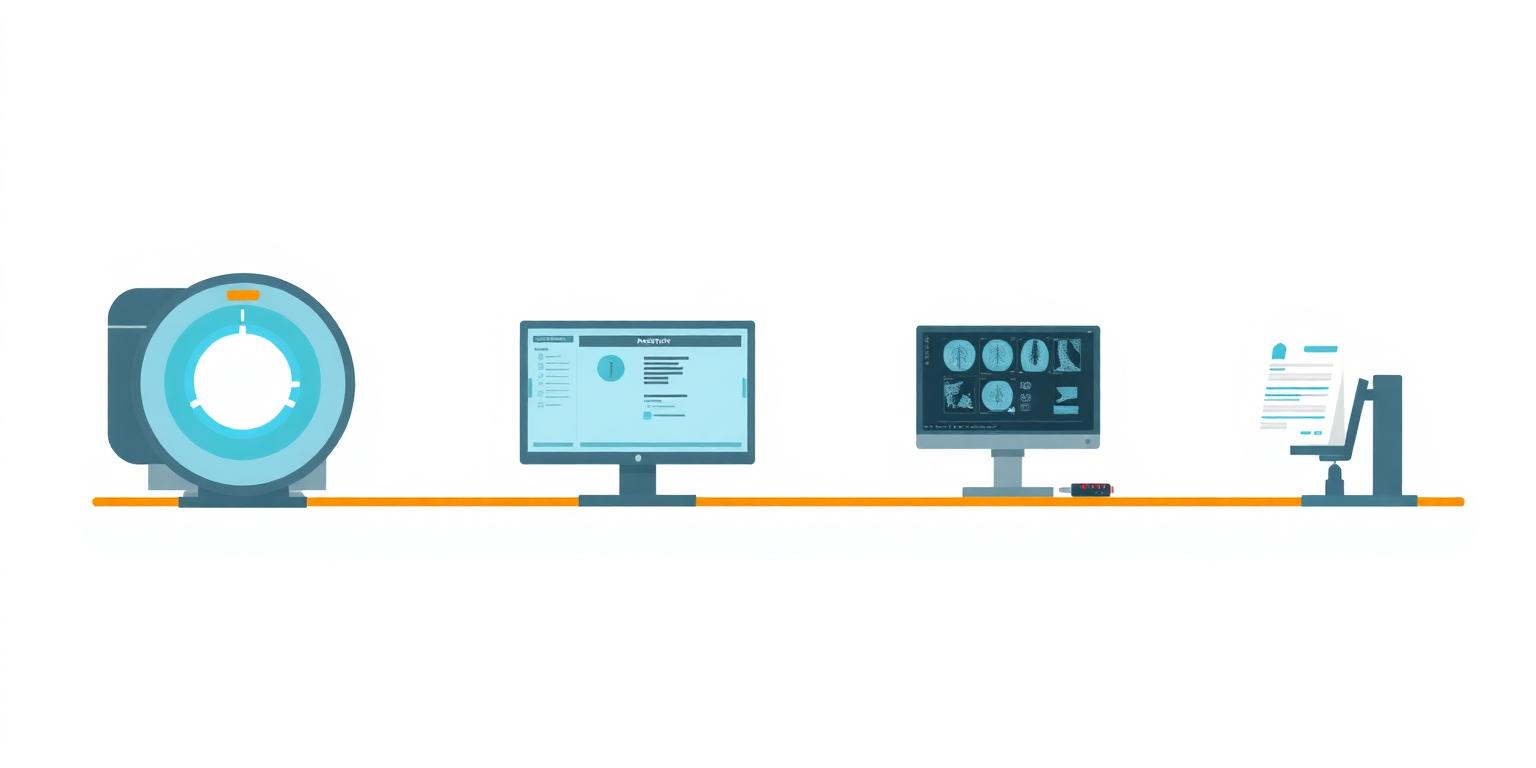
Preliminary reads are usually explained in a single sentence — a fast initial interpretation issued before the final report — and that sentence, while accurate, tells an imaging director almost nothing useful about how the arrangement behaves in their department at two in the morning. The questions that actually matter are operational. Where does the study go? Who touches it, in what order? What happens when the finding is a bleed? Who signs, and when? This guide walks the full sequence, stage by stage.
⚠️ Important scope note — please read before continuing
RAD365 provides offshore preliminary reads for human patients in the USA only — we do not provide final reads. Your facility's own licensed radiologist completes and signs every final interpretation.
For veterinary and pet imaging there are no preliminary reads; veterinary studies are read as complete final reports by specialist veterinary radiology groups.
By Trisha Seal · August 26, 2026 · Written from RAD365's operational experience running offshore preliminary-read workflows integrated directly into hospital PACS, worklist and escalation environments for USA facilities.
growth in US radiology exam volumes, 2018 to early 2024 (JACR analysis via Radiology Business)
growth in the number of working radiologists over the same six-year span
projected physician shortfall by 2034 in the specialty group including radiology (AAMC)
the rate at which radiologists now leave practice vs. under a decade ago (Neiman HPI / ACR Bulletin)
Stage 1 — The study lands on your PACS worklist, exactly as always
The most important thing to understand about the first stage is how little changes. The technologist completes the examination and performs the same technical quality check they always have: coverage, positioning, motion, artefact, contrast timing. The modality sends the completed study to the facility's PACS over the same connection it has always used. Nothing about acquisition, hanging protocols, or the facility's record of the study is altered by the presence of a preliminary read layer.
What is added is a routing decision. Rules evaluate each study against criteria the facility defines — modality, ordering location, order priority, time of day — and forward qualifying studies over an established secure connection to the reading worklist, carrying relevant priors alongside them. Studies that do not match the rules never leave. This is the stage where most implementations succeed or quietly fail, because a routing configuration that requires a technologist to remember to do something manually will be followed for about three weeks. The integration model behind our offshore preliminary reads is built specifically around removing that human step.
What to verify before go-live
- Order priority survives the hop. A STAT order must present as STAT on the reading side, or tiered turnaround exists only on paper.
- Priors travel with the study. An interpretation without comparison is a weaker interpretation.
- Routing is automatic and rule-based. No manual export, no separate upload step, no dependence on memory.
- Failure is visible. If a study fails to route at 2 AM, someone must be alerted — silence is not success.
Stage 2 — The reading radiologist picks it up and issues the preliminary interpretation
The study appears on the reading worklist ordered by urgency, with priority studies visually distinguished so they cannot be lost in a queue. A reading radiologist interprets it and produces a documented preliminary report: time-stamped, attributed to a named physician, and unambiguously labeled as preliminary rather than final.
Turnaround here is contracted in tiers, not quoted as one number. STAT and emergency studies are typically targeted in the region of 20 to 30 minutes from availability on the reading worklist; urgent studies within roughly an hour; routine overflow within a longer window agreed against the department's reporting rhythm. Two questions decide whether those tiers mean anything in practice: where exactly the clock starts and stops, and what measured historical performance against each tier looks like over the previous twelve months. Targets are trivially easy to write into a proposal. Measured performance is not.
The preliminary report then returns into the facility's existing worklist and record — not into a separate portal that staff must remember to check. That detail sounds administrative and is in fact the single strongest predictor of whether a technically sound arrangement is still being used properly six months after go-live.
Stage 3 — Critical findings escalate immediately, with an audit trail
When a reading radiologist identifies a finding on the facility's critical-findings list, the timeline stops being about turnaround targets and starts being about direct human contact. The list itself is defined by the facility, not the reading provider — typically covering intracranial haemorrhage, acute stroke findings, large or tension pneumothorax, aortic dissection, free intraperitoneal air, pulmonary embolism and comparable time-critical findings.
The escalation is not a message left in a system. It is direct contact with the named on-shift provider by the agreed method, verbal confirmation that the message was received and understood, and a time-stamped log entry recording who was contacted, when, by whom, and what was communicated. That log is not paperwork for its own sake; it is the only durable evidence that the escalation happened, and it is the first thing an auditor or a malpractice review will ask for.
Worth testing after go-live rather than assuming: what happens when the first contact does not answer. A protocol with a defined second and third contact, exercised at least once in a drill, behaves very differently at 3 AM from one that exists only as a paragraph in a contract.
Stage 4 — Your radiologist reviews and signs the final interpretation
The facility's own licensed radiologist reviews the study independently on their normal reporting schedule and issues the signed final report. That report is the diagnostic record, the billable interpretation, and the document that stands in the patient's chart. The preliminary interpretation supported a decision that could not wait; it did not replace this step and was never intended to.
The requirement is regulatory rather than stylistic. The signing physician must hold a license in the state where the patient is located and be credentialed and privileged at the facility, and the professional component is billed against their signature. This is why RAD365 provides preliminary interpretations only for human patients in the USA and never final reads — and why any proposal that is vague about who signs deserves considerably more scrutiny, not less. The wider workflow context sits within our human radiology services coverage.
The four stages, side by side
| Stage | Who acts | Typical timing | Output |
|---|---|---|---|
| 1. Acquisition & routing | Technologist, modality, PACS routing rules | Seconds to minutes after study completion | Study on the facility worklist and forwarded to the reading queue |
| 2. Preliminary interpretation | RAD365 offshore reading radiologist | Tiered — STAT typically ~20–30 min, urgent ~1 hr, routine longer | Time-stamped, attributed, clearly labeled preliminary report |
| 3. Critical-finding escalation | Reading radiologist → named on-shift provider | Immediately on identification, per facility protocol | Verbal contact plus a logged, time-stamped communication record |
| 4. Final interpretation | Facility's own licensed radiologist | Next normal reporting cycle | Signed final report — the diagnostic and billable record |
Why the two-step model exists at all
The sequence above is not an accident of tradition; it is a response to a supply curve. Per a JACR-based analysis reported by Radiology Business, US radiology exam volumes grew roughly 31% between 2018 and early 2024 — close to 5% a year — while the number of working radiologists grew only about 24% across that same six-year period. A several-point annual gap compounds quickly, and no individual facility recruits its way out of a national capacity constraint.
The exit side compounds it further. Per the Harvey L. Neiman Health Policy Institute's workforce update reported via the ACR Bulletin, radiologists are now leaving practice entirely at more than twice the rate they were less than ten years ago, with subspecialty radiologists 37% more likely to exit than their peers. The AAMC's most recent physician workforce projections report a shortfall of 10,300 to 35,600 physicians by 2034 in the specialty group that includes radiology, and note that more than 40% of US physicians will reach age 65 or older within the next decade.
The cost side explains why the answer is a layer rather than a hire. Per a Medscape physician compensation survey reported by Radiology Business, average radiologist compensation reached $571,000 in the latest survey year, up 9% year over year — and continuous overnight cover is a rota, not a single position. A preliminary layer is a financially rational complement to a stretched in-house bench, absorbing the hours that cannot be permanently staffed, while the bench does what only it can do: sign.
Where the timeline usually breaks
- Priority is lost in routing — every study arrives looking the same and tiering becomes decorative.
- Reports return to a separate portal — adherence decays quietly while the invoice keeps arriving.
- The escalation path was never tested — nobody knows what happens when the first number does not answer.
- Discrepancy comparison is manual — so it happens sporadically, then stops.
- Nobody owns connectivity at 2 AM — routing failures sit undetected until morning.
Four of those five are integration and governance problems rather than clinical ones, which is the general lesson of the whole sequence. Reading quality is necessary and rarely the binding constraint; the constraint is almost always the plumbing and the protocol around it. Measuring that quality over time is where a structured peer review and QA program earns its place, comparing every preliminary interpretation against the signed final report and trending the actionable discrepancy rate rather than the raw one.
Preliminary reads: frequently asked questions
The Preliminary Read Timeline, Step by Step
How long does it typically take to get a preliminary read after a scan is completed?
Turnaround is contracted in tiers rather than quoted as a single number, because a suspected intracranial haemorrhage and a routine outpatient follow-up do not warrant the same clock. In practice, STAT and emergency studies are typically targeted in the range of roughly 20 to 30 minutes from the moment the study is available to the reading radiologist, urgent studies within about an hour, and routine overflow volume within a few hours or by the next reporting cycle. What matters more than the headline figure is where the clock starts and stops: a target measured from when the study reaches the reading worklist behaves very differently from one measured from acquisition, particularly if transfer is slow. Ask for measured historical performance against each tier, not the target.
Who actually looks at the images first — the technologist, the preliminary reader, or the final radiologist?
The technologist sees the images first, but not as an interpreter. Their review is a technical quality check: correct anatomy captured, adequate coverage, acceptable positioning, no motion or artefact severe enough to compromise the study, contrast timing correct where relevant. They are checking whether the study is diagnostic, not what it shows. The preliminary reader is the first physician to interpret the images and produce a documented impression. The facility's own licensed radiologist then reviews the study independently and issues the signed final report. Each of the three has a distinct role, and a well-run workflow keeps those roles unambiguous in the documentation as well as in practice.
What happens to a study between the moment it's captured and the moment a preliminary read is issued?
The modality sends the completed study to the facility's PACS exactly as it always has — nothing about acquisition changes. Routing rules then evaluate the study against criteria such as modality, ordering location, order priority and time of day, and forward qualifying studies over the established secure connection to the reading worklist. Relevant priors travel with it, since an interpretation without comparison is a weaker one. The study appears on the reading radiologist's worklist ordered by urgency, is interpreted, and the preliminary report returns into the facility's existing worklist and record. On a healthy connection the transport portion is measured in seconds to a couple of minutes; when it is not, the cause is almost always network or firewall configuration rather than reading capacity.
Does the preliminary read timeline change for STAT versus routine studies?
Yes, and the difference should be structural rather than best-effort. STAT studies are flagged at the point of order, carried through the routing rules as a priority attribute, and surfaced at the top of the reading worklist with a distinct visual treatment so they cannot be missed in a queue. Routine overflow studies sit in a lower tier with a longer contracted target. The failure mode worth guarding against is priority information being lost in transit — if the order priority does not survive the routing hop, every study arrives looking identical and the tiering exists only on paper. Verify during onboarding that a STAT order actually presents as STAT on the reading side.
What triggers a critical-finding escalation during the preliminary read process?
The trigger list is defined by the facility, not by the reading provider, and it is written into the protocol before go-live. Typical entries include intracranial haemorrhage, acute stroke findings, tension or large pneumothorax, aortic dissection or aneurysm rupture, free intraperitoneal air, bowel obstruction with ischaemic features, pulmonary embolism, and unexpected findings requiring intervention within hours. When a reading radiologist identifies anything on that list, the escalation path activates: direct contact with the named on-shift provider by the agreed method, verbal confirmation that the message was received and understood, and a time-stamped log entry recording who was contacted, when, by whom and what was communicated. The documentation is not administrative overhead — it is the evidence the escalation happened.
Preliminary vs. Final: Roles and Responsibility
Who is legally responsible for the interpretation in a patient's chart — the preliminary reader or the final radiologist?
The diagnostic interpretation of record belongs to the facility's own licensed radiologist, who reviews the imaging independently and signs the final report. That structure is fixed by state medical licensure, hospital credentialing and privileging, and facility billing rules — it is not a contractual preference either party can negotiate. The preliminary reader is professionally accountable for the quality of the preliminary opinion they issue and for following the escalation protocol, but issuing a preliminary interpretation does not transfer diagnostic authority away from the facility. This is precisely why RAD365 provides preliminary reads only for human patients in the USA and never final reads; any provider blurring that line is describing something outside our scope.
Can a preliminary read differ from the final read, and how often does that happen?
Yes, and a mature program measures it rather than hoping about it. Differences fall into three bands: no material difference, minor variation in wording or descriptive emphasis that changes nothing clinically, and actionable discrepancy — a difference that would have altered patient management. Headline discrepancy rates always look higher than people expect because they include the middle band, which is why the actionable rate is the only figure worth comparing between partners. Ask any prospective provider for their measured actionable discrepancy rate, the methodology that produced it, and what happens to an individual reader after a flagged case. Systematic comparison of this kind fits naturally alongside a department's existing peer review and QA program.
Does a preliminary read ever get billed to insurance or Medicare on its own?
No. The professional component for a diagnostic imaging interpretation is billed against the signed final report produced by the facility's credentialed, licensed radiologist. A preliminary interpretation is a documented clinical support opinion, not a billable interpretation of record, and it is not submitted separately to Medicare or a commercial payer. Commercially, the preliminary layer is contracted directly between the facility and the reading provider — usually on a per-study or coverage-block basis — and sits on the cost side of the ledger rather than the revenue side. If a proposal implies otherwise, that is a reason to slow down and involve your compliance and revenue-cycle teams.
What is a "wet read," and how does the term connect to today's offshore preliminary reads?
"Wet read" is a film-era term. When radiographs were developed chemically, a radiologist would sometimes give a rapid verbal impression while the film was still literally wet, before the formal dictated report existed. The vocabulary survived the technology because the underlying need did not change: clinicians frequently need an answer faster than the report of record can be produced. Modern offshore preliminary reads are the same clinical function rebuilt with digital infrastructure — documented rather than verbal, time-stamped and attributed rather than informal, delivered over secure DICOM routing rather than a corridor conversation, and governed by written escalation and audit protocols. The intent is identical; the accountability structure is far stronger.
Why can't the preliminary read simply become the final read to save time?
Because the constraint is regulatory and credentialing-based, not technical. The physician signing the report of record for a human patient in the USA must hold a license in the state where the patient is located and be credentialed and privileged at that facility, and the facility's billing for the professional component depends on that. Those requirements cannot be satisfied by a reading physician outside that framework, regardless of interpretation quality. Beyond compliance, there is a clinical argument for keeping the two steps distinct: independent review of the same imaging by a second physician is a genuine quality mechanism, and collapsing it into one step to save time would remove a safeguard the two-step model provides for free.
Why This Two-Step Model Exists (Workforce & Volume Context)
Why do so many US hospitals rely on a preliminary-then-final read model instead of one radiologist doing everything?
Because imaging is acquired around the clock and radiologists are not available around the clock in most facilities. A community hospital with three or four radiologists cannot staff a continuously covered overnight rota without either burning out the group or hiring against a peak that exists for only part of the year. The two-step model resolves this by separating the timing of the clinical answer from the timing of the diagnostic record: the emergency physician gets a documented impression in minutes, and the facility's radiologist reads and signs on a sustainable schedule. It is a scheduling solution to a coverage problem, and the compliance boundary between the two steps stays fixed throughout.
How much has US radiology imaging volume grown compared to the radiologist workforce?
The gap is measurable and widening. Per a JACR-based analysis reported by Radiology Business, US radiology exam volumes grew roughly 31% between 2018 and early 2024 — close to 5% a year — while the number of working radiologists grew only about 24% over that same six-year span. That is not a crisis in a single year, but compounding a several-point annual gap over a decade produces a structural capacity shortfall no individual facility can recruit its way out of. It is the single clearest quantitative reason the preliminary read category has grown from a niche overnight arrangement into standard operating infrastructure for a large share of US imaging departments.
What does it cost a hospital to staff radiology coverage entirely in-house versus using an offshore preliminary read layer?
The comparison is between a fixed cost and a variable one, which is why unit-price arguments mislead. Per a Medscape physician compensation survey reported by Radiology Business, average radiologist compensation reached $571,000 in the latest survey year, up 9% year over year — and continuous overnight cover is not one such position but a rota, plus recruitment, benefits, leave cover, and the retention risk attached to an unpopular schedule. A contracted preliminary layer is a variable cost that tracks actual volume and flexes during surges and vacancies. The honest evaluation compares the full annual cost of covering the same specific hours to the same depth. It is a complement to a stretched in-house bench, not a replacement for one.
Are radiologists actually leaving the workforce faster than new ones are being trained?
The exit side is accelerating measurably. Per the Harvey L. Neiman Health Policy Institute's workforce update reported via the ACR Bulletin, radiologists are now leaving practice entirely at more than twice the rate they were less than ten years ago, and subspecialty radiologists are 37% more likely to exit the workforce than their peers. The AAMC's most recent physician workforce projections point the same direction, reporting a shortfall of 10,300 to 35,600 physicians by 2034 in the specialty group that includes radiology, and noting that more than 40% of US physicians will reach age 65 or older within the next decade. Residency expansion moves on a much slower timescale than attrition does.
Is the preliminary read model a temporary stopgap or a structural shift in US radiology staffing?
The data points toward structural. A stopgap implies the underlying condition resolves — but exam volume growth is outpacing workforce growth, attrition has roughly doubled, more than 40% of US physicians reach 65 or older within the decade per the AAMC, and training pipeline expansion takes the better part of a decade to affect supply. None of those curves reverse on a short horizon. What is more likely to change is the sophistication of the model rather than its existence: tighter PACS integration, better-defined turnaround tiering, stronger discrepancy measurement, and more explicit contractual scope boundaries. Facilities treating it as a permanent operating layer tend to buy it better than those treating it as an emergency purchase.
Compliance, Audit, and Trust
What documentation exists to prove a preliminary read was reviewed and signed off by a final radiologist?
The evidence chain has four links, and all four should be reconstructable from system records rather than from memory. First, the preliminary report itself: time-stamped, attributed to a named reading physician, and unambiguously labeled preliminary. Second, the PACS and RIS record showing the facility radiologist opened the study and its priors. Third, the signed final report with its own timestamp and signing physician. Fourth, where a critical finding occurred, the communication log recording who was contacted, when and by whom. An auditor should be able to walk a single accession number through all four in minutes. If assembling that chain requires cross-referencing spreadsheets, the documentation is not operational.
How do facilities audit the accuracy of their preliminary read partner over time?
Through continuous structured comparison rather than periodic spot checks. Every preliminary interpretation is matched against the corresponding signed final report, differences are logged and classified by clinical significance, and the actionable discrepancy rate is trended over time by modality, by body region and by individual reader. Trend direction matters as much as the absolute figure: a stable rate with individual outliers being addressed is a functioning quality system, while a slowly rising rate nobody has commented on is not. Sustainable programs automate the comparison rather than relying on manual review, and route findings into the department's existing peer review and QA structure instead of maintaining a parallel process.
What should a radiology director ask a preliminary read vendor about escalation and audit trail process before signing a contract?
Ask who defines the critical-findings list — the correct answer is the facility. Ask exactly how contact is made out of hours, who is called if the first contact does not answer, and how many attempts are made before the path escalates further. Ask what is logged for each communication and how quickly you can retrieve a specific escalation record on request. Ask how the escalation protocol is tested after go-live, since a path nobody has exercised is a path nobody knows works. Ask for individual-level access logs, current credentialing records for every reading physician, and a sample audit package covering one accession end to end. Anything a provider will not put in writing is not part of the service.
Related resources
- Offshore preliminary reads for USA facilities — full scope, turnaround tiers and compliance structure
- How preliminary read coverage integrates with an existing PACS worklist
- Human radiology services overview
- Peer review and quality assurance programs
- PACS and imaging infrastructure support
Want this mapped against your own workflow?
Send us your volume-by-hour picture and current routing setup, and we'll walk you through exactly where a preliminary read layer would sit — and where it would not help.
Talk to our team →