Vet PACS Support in 2026: What the Veterinary Imaging Growth Data Says
Veterinary imaging is a $2.4B+ market growing 7%+ a year while practices staff no imaging IT. What vet PACS support covers, and what it costs to skip.
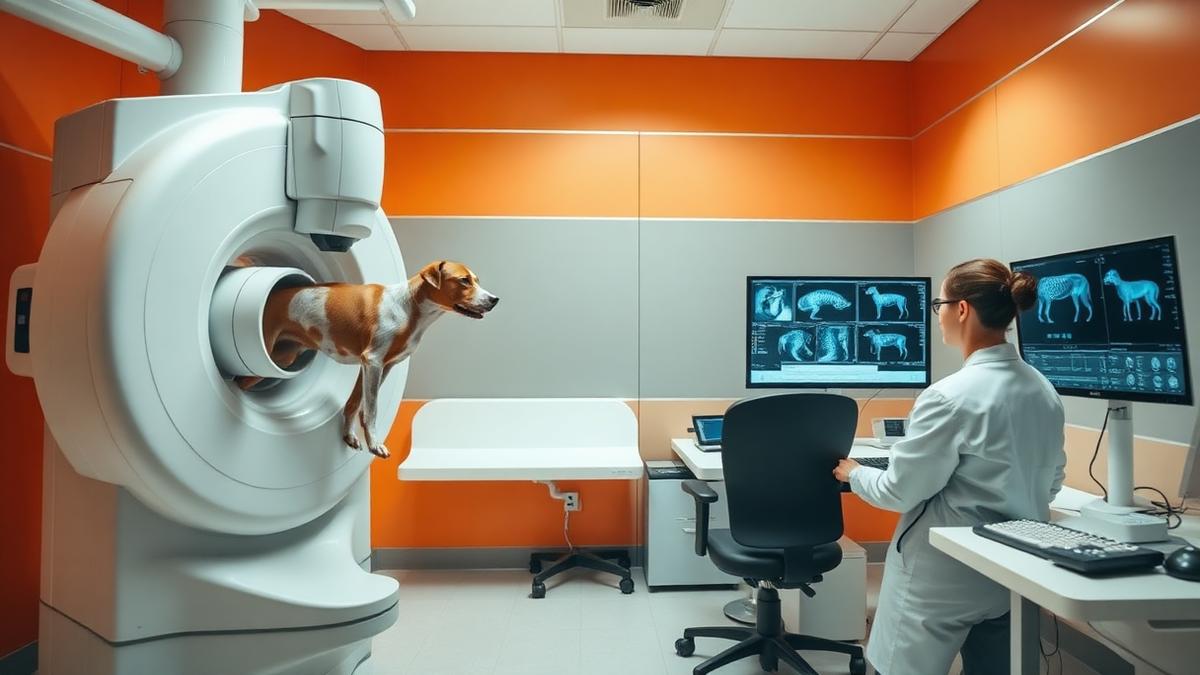
Demand for vet PACS support is not a marketing invention; it is what happens when imaging volume in veterinary medicine grows faster than practices can staff for it. The numbers below explain why an entire support category has formed around veterinary imaging infrastructure in the past few years, and what practices are actually buying when they outsource it. The service scope itself sits on the veterinary PACS support page.
global veterinary imaging market, 2025 to 2026 (Fortune Business Insights, MarketsandMarkets)
projected CAGR toward $3.3–4.16B by the early 2030s
reported industry-wide vacancy rate for veterinary radiologists
average US veterinary radiologist salary, July 2026 (ZipRecruiter) — $96.91/hour
The growth curve nobody staffed for
According to market research from Fortune Business Insights and MarketsandMarkets, the global veterinary imaging market was valued at roughly $2.2 billion in 2025 and is projected to reach approximately $2.4–2.5 billion in 2026, growing at a 7.2–7.8% compound annual rate toward somewhere between $3.3 billion and $4.16 billion by the early 2030s.
Read that as equipment and study volume rather than as an abstract market size. It means more digital radiography panels, more in-house ultrasound, more CT installed in general practices that would have referred those cases five years ago, and more studies per patient. Every one of those additions creates archive load, network traffic, integration points and configuration that somebody has to own.
The staffing side has not moved on the same curve. Most single-site practices have no dedicated IT staff at all, and multi-site groups typically run a small generalist team covering the entire estate. Imaging infrastructure ends up owned informally by whoever is most comfortable with computers — frequently a practice manager or a lead technician doing it on top of a full clinical role.
The specialist-cost arithmetic
Two further data points explain why outsourcing wins on arithmetic rather than on ideology. Veterinary radiologists face a persistent workforce shortage, with vacancy rates around 20% reported industry-wide, which makes round-the-clock in-house specialist coverage unrealistic for most practices. And ZipRecruiter's July 2026 data puts the average US veterinary radiologist salary at approximately $201,579 a year, or $96.91 an hour.
An imaging IT specialist is a different role with a different rate, but the shape of the problem is identical: scarce, expensive, imaging-adjacent expertise that a single site cannot fill a whole week for, and that no practice can cover across nights and weekends with one hire. Outsourced coverage exists because the alternative is a headcount most practices cannot justify and, at current vacancy rates, might not be able to fill anyway.
Stat callout
A market growing at 7.2–7.8% a year against a specialist vacancy rate of around 20% is the entire business case for managed veterinary imaging support. The imaging estate compounds; the internal capacity to run it does not.
What 24/7 vet PACS support actually includes
The phrase covers a wide range in practice, so it is worth being specific about the components a full engagement should contain.
- Continuous monitoring of archive availability, storage headroom, DICOM send queues, modality connectivity and backup jobs, with thresholds tuned to each site's normal traffic instead of vendor defaults.
- Incident response under defined priority classes, with out-of-hours engineers authorised to make configuration changes rather than log a message for the morning.
- Routine administration — users, worklists, modality configuration, hanging preferences, license and certificate renewals.
- Integration management between the imaging chain and practice management software, so patient identity and orders flow correctly and studies are reachable from the patient record.
- Backup and recovery with verified restores on a schedule, not backup jobs that report success and have never been tested.
- Change and upgrade coordination, including verification after modality firmware updates — a routine and frequently overlooked cause of broken sends.
- Reporting per site, so a network can see where incidents concentrate rather than receiving a single aggregate number.
Where a practice already has a general IT provider, the demarcation matters as much as the scope: general IT keeps the endpoints, network and practice management platform healthy, while imaging-specific work sits with the team that owns the imaging chain. That split — and the day-to-day service desk behind it — is described on the vet IT support page.
In-house vs. outsourced: total cost of ownership
| Cost component | In-house / self-managed | Outsourced vet PACS support |
|---|---|---|
| Server, storage, refresh cycle | Capital plus refresh every 4–5 years | Included or managed against a plan |
| Backup and tested restore | Often configured once, rarely tested | Verified on schedule, reported |
| Staff time on imaging faults | Largest hidden cost — clinical hours | Absorbed by the provider |
| Out-of-hours coverage | Effectively none | Contracted, monitored |
| Multi-site consistency | Drifts per clinic | Standardized and documented |
| Recovery from a major failure | Unbudgeted, potentially data-losing | Planned, rehearsed, bounded |
The line that surprises most practice owners is the third one. When the informal internal effort is counted honestly — clinical staff hours spent restarting things, re-entering identity by hand, chasing studies that did not arrive — the self-managed option is usually not the cheaper one, it is simply the one whose cost never appears on an invoice.
What growing practices should do first
- Inventory the imaging chain per site: modalities, AE titles, routing rules, archive, viewer, backup target, integration points.
- Test a restore. Not the backup report — an actual restore of a real study to a working viewer.
- Forecast storage against the growth curve above, including any CT or MRI you expect to add.
- Name an owner internally, even when the depth is outsourced, so change decisions have a home.
- Write down the demarcation between general IT and imaging support so no layer is assumed to be someone else's.
Practices running multiple locations should extend that inventory to the cross-site transfer paths, which is where most avoidable veterinary imaging incidents originate. Full coverage detail is on the vet PACS support service page.
About the author
Trisha Seal writes on veterinary imaging operations and PACS infrastructure for RAD365. RAD365 provides managed veterinary PACS and imaging IT support — 24/7 engineers, vendor-agnostic coverage across multi-site estates, DICOM connectivity management and practice management integration. The scope of this page is systems and infrastructure support.
Get your veterinary imaging estate covered
Talk to a RAD365 engineer about 24/7 monitoring, DICOM connectivity and multi-site PACS support for your practice.
Talk to a vet PACS engineer →Vet PACS support: frequently asked questions
Vet PACS Support Basics
What is vet PACS support, and how does it differ from human medical PACS support?
Vet PACS support is the operational management of a veterinary practice's imaging systems — the archive, viewer, DICOM routing, modality connections and the link into practice management software. The technical layer is largely the same standards stack used in human imaging, but the operating context is not: veterinary practices run far smaller IT teams (often none), work with a wider mix of species, body sizes and modality configurations, and integrate with practice management platforms rather than a hospital EHR. Support that has only worked in hospital environments tends to underestimate how much of the value is in that integration layer.
Which kinds of companies specialize in PACS support for veterinary practices?
Three groups do this work. General IT managed service providers who treat imaging as another application; imaging system vendors, whose support is scoped to their own product; and specialist imaging-operations providers who run PACS, DICOM and modality connectivity across mixed estates as their core business. The third group is usually the right fit for a multi-site practice, because most veterinary imaging faults sit in the gaps between products — routing, worklist, storage and practice-management integration — which is exactly where product-scoped support stops.
How do I set up and maintain a PACS system in a small veterinary clinic?
Start with the archive decision — where studies live, how they are backed up, and how long they are retained — because that governs everything else. Then configure modality connectivity properly with documented AE titles and a modality worklist so studies arrive with correct patient and owner identity instead of being typed at the console. Add a viewer your veterinarians will actually use, then set up monitored backup and a tested restore. Maintenance is small but non-optional: storage headroom checks, patching, certificate and license renewals, and verification after every modality firmware update.
What imaging formats and modalities should a vet PACS system support?
DICOM as the baseline for digital radiography, CT, MRI, ultrasound and fluoroscopy, including multi-frame ultrasound cine loops, which some lightweight systems handle poorly. Beyond that, practices increasingly need to store non-DICOM material against the same patient record — endoscopy video, dermatology and surgical photographs, referral PDFs — so an archive that can hold and index encapsulated or attached objects saves a parallel filing system later. Confirm cine and large-series handling before purchase rather than after.
How does vet PACS support improve diagnostic accuracy and workflow in an animal hospital?
Mostly by removing the friction that degrades both. Reliable modality worklist means correct patient identity on every study, so priors reliably attach to the right animal. Fast, consistent viewer performance means clinicians actually window and measure rather than glancing at a thumbnail. Working routing means the study reaches whoever needs it without a manual export. None of that is glamorous, but a study that is mislabelled, slow to load or stranded on a console is a study that gets less clinical attention than it deserves.
Why Demand Is Growing
Why is veterinary imaging volume growing faster than in-house IT teams can keep up with?
Because the imaging side is scaling and the support side is not. The global veterinary imaging market was valued at roughly $2.2 billion in 2025 and is projected to reach approximately $2.4–2.5 billion in 2026, growing at a 7.2–7.8% CAGR toward $3.3–4.16 billion by the early 2030s, according to market research from Fortune Business Insights and MarketsandMarkets. Practices are adding modalities, sites and study volume at that pace, while most still have zero dedicated imaging IT staff. The gap is filled by whoever is nearest the problem — usually a practice manager or a lead technician.
How does a veterinary practice know it has outgrown its current PACS support?
Common signals: studies that regularly need manual intervention to reach the archive; a growing list of workarounds nobody has documented; incidents resolved by restarting things rather than by explanation; storage decisions being made reactively when a disk fills; nobody able to say when the last successful restore test happened; and a support provider who has to ask what your modalities are every time you call. Multi-site practices usually notice it first as inconsistency — one clinic's imaging behaves differently from another's.
What 24/7 Support Includes
What does 24/7 vet PACS support include for multi-site veterinary networks?
Continuous monitoring of archive, storage, routing and modality connectivity across every site; incident response under defined priority classes with out-of-hours engineers who can make changes rather than take messages; day-to-day administration such as users, worklists and modality configuration; DICOM connectivity management between sites; backup verification and tested restores; patching and upgrade coordination; and monthly reporting per site so a network can see which location is generating the incidents. Coverage detail is set out on the veterinary PACS support page.
How does outsourced vet PACS support differ from a general IT helpdesk?
A general helpdesk owns endpoints, networks, email and practice management software, and treats imaging as one more application. It is usually excellent at the first four and out of its depth on DICOM negotiation failures, worklist query problems, storage-class mismatches and modality-specific behavior. Vet PACS support owns the imaging chain specifically. Most practices end up with both: the helpdesk for the general estate, an imaging specialist for the imaging estate, with a clear demarcation so neither assumes the other is watching.
Does vet PACS support include DICOM connectivity management across locations?
It should. Multi-site veterinary networks depend on studies moving reliably between clinics, referral partners and the central archive, which means managed routing rules, documented AE titles, secure transport, and monitoring of the transfer itself rather than just of the endpoints. A managed DICOM gateway approach — described on the vet DICOM gateway page — is what stops a firmware update at one clinic from silently breaking sends to the archive.
What SLA response times are standard for veterinary PACS emergencies?
For a critical incident — imaging stopped, archive unreachable, no access to priors during an active case — expect a live engineer engaged within minutes and continuous updates until restoration, with root-cause analysis afterwards. Lower priority classes typically carry same-business-day or next-business-day targets. What matters more than the published number is the measurement rule: whether the clock starts at the monitoring alert or at your phone call, and whether performance is reported at the average or at the 95th percentile.
What happens if a veterinary practice's imaging archive goes down overnight?
Without monitored support, usually nothing until morning — and the morning is spent reconciling studies acquired during the gap, some of which will have been stored only on modality consoles with inconsistent identity. With monitored support, the alert fires at the point of failure, an engineer restores or fails over the archive, modalities are held or re-pointed so nothing is lost, and the overnight studies are reconciled before the day list starts. The difference is rarely the outage duration; it is whether anyone has to unpick the data afterwards.
Cost, Integration and Scaling
What's a realistic cost range for managed veterinary PACS support?
Cost is driven by the number of sites, the modality mix, study volume, archive size and retention policy, whether the coverage window includes nights and weekends, and how much legacy equipment is in the estate. Rather than benchmarking a headline figure, compare total cost of ownership: what your current arrangement costs in licenses, storage, ad hoc IT time, staff hours spent on workarounds, and the clinical cost of imaging downtime. Most practices find the informal internal effort is the largest and least visible component.
How does vet PACS support integrate with practice management software like Cornerstone, AVImark or eVetPractice?
Through the identity and order layer. The goal is that a patient created in the practice management system flows to the modality worklist so studies are acquired with correct owner, patient and accession identity, and that completed studies are visible from the patient record without a manual lookup. Depending on the platform, that is achieved through HL7 messaging, a supported integration bridge, or a middleware layer. This integration is where most veterinary imaging support work actually lives — day-to-day workflow help is covered on the vet workflow manager page.
Can vet PACS support scale as a practice adds modalities like CT or MRI?
Yes, but the scaling is mostly in storage, network and retention planning rather than in the viewer. A CT or MRI addition multiplies study size dramatically, changes backup windows and can expose network bottlenecks between the modality room and the archive that a DR-only practice never noticed. Good support plans that before the modality arrives: capacity forecast, storage tiering, transfer path testing, worklist configuration and a retention policy that accounts for the new data volume.
How does vendor-agnostic vet PACS support handle multiple imaging vendors across a network?
By working at the standards layer that all the vendors share — DICOM services, conformance statements, storage classes, network transport — and holding a documented map of what each site actually runs. Multi-vendor estates are the norm in veterinary networks that have grown by acquisition, where each clinic arrived with its own DR panel, ultrasound and archive. Vendor-agnostic support diagnoses at the protocol level, resolves what it can, and manages escalation to the specific product vendor when the fault is genuinely theirs.
Is vet PACS support the same as veterinary imaging operations workflow support?
No — they are two separate RAD365 service lines and should not be conflated. Vet PACS support is systems and IT work: keeping the archive, viewer, routing, modality connectivity and integrations running, with no involvement in clinical clinical documentation. workflow support are a distinct offering covered separately on the veterinary radiology page. A practice can engage either independently; buying PACS support does not include case activity, and buying case activity does not include managing your imaging infrastructure.
What migration risks should multi-location veterinary networks watch for when switching PACS support providers?
Undocumented configuration is the big one — routing rules, AE titles and integration mappings that exist only in the outgoing provider's heads. Also watch for archive access and export terms in the outgoing contract, study-count reconciliation across every site rather than in aggregate, priors that stop hanging correctly after identity remapping, and credential handover for modality and vendor portals. Insist on a written runbook and a validated inventory before the old provider leaves, and keep the old environment readable until reconciliation is signed off.
