How One Veterinary Network Fixed Its Imaging Archive Before It Became a Liability
A composite case study in vet PACS support: how a four-clinic veterinary network moved from informal imaging IT to managed support, and what changed month by month.
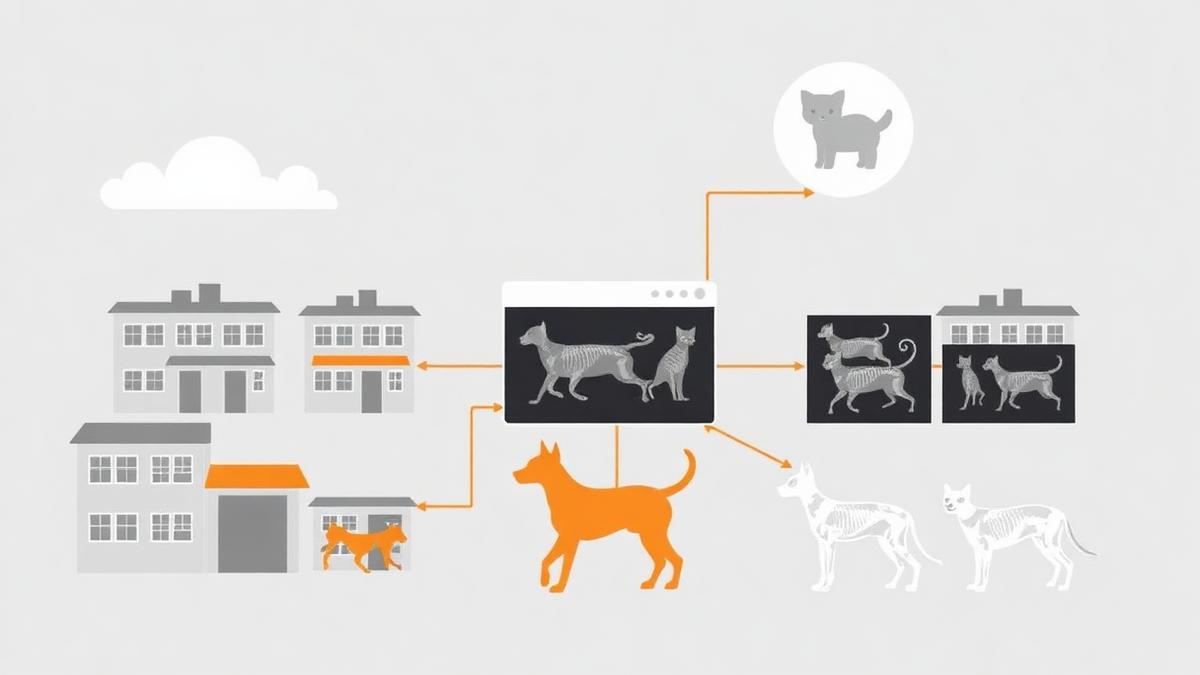
The clearest way to explain what vet PACS support actually does is to follow a network that went without it for too long. What follows is a composite account drawn from patterns RAD365 sees repeatedly across multi-site veterinary groups — a four-clinic practice whose imaging archive had quietly become the most fragile system in the business, and what changed once managed veterinary PACS support replaced an informal arrangement. Names and details are generalised; the sequence is not.
The week it stopped being an annoyance
The practice had grown from one clinic to four in six years, two of them acquisitions. The imaging setup had grown with it, in the way these things do — a server bought for the original clinic, additional modalities added as budget allowed, remote access configured one afternoon by a technician who had since moved to another practice.
Nobody had decided this was the architecture. It just accumulated.
The week that changed it involved a referral case where a prior study from the acquired clinic existed but could not be retrieved. Not lost — retrievable, eventually, by someone who knew which of two identifier schemes that site had used before the merge. The attending veterinarian did not have that person's phone number at 8pm. The case proceeded without the comparison.
Nothing catastrophic happened. That is usually how it goes, and it is why these problems persist. But the practice's operations lead started counting afterwards, and the counting is what actually moved the decision.
What the counting showed
Three weeks of informal tracking produced a picture nobody had seen before. Imaging problems were consuming somewhere between four and seven hours of the operations lead's week — not fixing systems, but coordinating around them: finding studies, arranging transfers, chasing the modality at the newest site that had stopped sending after a service visit and had been going unnoticed for an unknown number of days.
The backup had last been restore-tested at installation. Four years earlier.
Two of the four sites were running workstation software several versions behind. Nobody could produce a list of who had access to the archive, because access had been granted informally as staff joined and had never been removed as they left.
The internal case
The operations lead's argument to the partners was not technical. It was that the veterinary imaging market — valued by Grand View Research and Straits Research at roughly $2.2B in 2025, an estimated ~$2.4B in 2026, and projected to grow at a 7.8% CAGR toward ~$4.0B by 2033 — was expanding faster than the practice could hire, and their imaging volume was tracking that curve while their imaging IT capability had not changed since 2020.
Why nobody had spare capacity to own it
The partners' first instinct was to make it someone's job internally. That conversation lasted about ten minutes once the staffing numbers came up.
NAVTA's 2023 workforce data reported a 15% vacancy rate in veterinary technician positions, with VHMA and AVMA practice surveys putting annual turnover in technician and assistant roles between 25% and 40%. Mars Veterinary Health's 2023 workforce study found that 65% of US veterinary clinics were operating with fewer staff than they needed. This practice was not an exception to any of it.
Assigning imaging IT to a technician who was already covering shortfalls on the clinical floor would produce exactly what they already had: an unofficial second job, done in gaps, with the institutional knowledge walking out at the next resignation — which, at 25–40% turnover, was a matter of when. Veterinary workforce research cites average annual losses of roughly $1.2 million tied to staffing gaps across practices; the partners did not need that figure to be precise to understand that adding an unfunded technical role to an understaffed clinical team was not a plan.
The alternative was to stop treating imaging infrastructure as something the practice did in its spare time. That is the point at which most groups look at veterinary IT support as a contracted function rather than a favour.
What the first ninety days looked like
Weeks 1–3: discovery, and the inventory nobody had
The first deliverable was not a fix. It was a document: every site, every modality, every workstation, every software version, every network path, every account with access to the archive. It ran to more pages than the partners expected. Two modalities were on firmware with published vulnerabilities. One site's studies were being routed through a path that had been intended as temporary in 2022.
Weeks 3–5: monitoring, and the restore test
Monitoring went in next, tuned to the network's actual traffic rather than vendor defaults — queue depths, send-failure rates, retrieval times per site, storage headroom. Within the first fortnight it caught the newest site's modality dropping its connection after every overnight power-saving cycle, a fault that had been intermittently reported for months and never reproduced during business hours.
The backup restore test was run properly for the first time in four years. It worked, with one gap: studies from the acquired clinic's legacy identifiers restored, but did not reliably link to their patient records. That is a defect you very much want to discover during a test.
Weeks 5–9: identity, and the merged-clinic problem
The identifier reconciliation was the largest single piece of work and the one that produced the most visible change. A master identifier scheme was defined, mapping rules were written for each legacy source, and a reconciliation report surfaced duplicates and mismatches for the practice's own staff to adjudicate — a few hundred records, worked through over three weeks. Afterwards, a prior study from any site could be found from any site, by anyone, without knowing the history of the merge.
Weeks 9–12: integration, access and the 11pm question
Orders began flowing from the practice management software to the modality worklists rather than being typed at the console, which removed a category of identity errors at source. Access was rebuilt around named accounts with roles, and eleven accounts belonging to people who no longer worked there were removed. Connectivity between sites and the archive was formalised through a managed veterinary DICOM gateway rather than the ad hoc routing that had accumulated.
And the after-hours question got a real answer. Previously, an 11pm failure meant a veterinarian texting a colleague. Now it meant a documented contact route reaching an engineer who already held the network's configuration and history.
What actually changed, measured
| Dimension | Before (informal) | After (managed support) |
|---|---|---|
| Ops lead time on imaging issues | 4–7 hrs/week | Under 1 hr/week |
| Cross-site prior retrieval | Depends who is working | Any site, any staff member |
| Backup assurance | Untested for 4 years | Scheduled restore testing |
| Faults logged | Text messages | Ticketed, trended, root-caused |
| Archive access list | Unknown | Named accounts, reviewed quarterly |
| 11pm failure | Vet troubleshoots alone | Monitored; engineer on call |
The partners' summary, eighteen months on, was not about uptime percentages. It was that imaging had stopped appearing in management meetings. A scope note worth stating plainly, because the market blurs it: everything described here is systems and infrastructure work. Veterinary image access and reporting services are a separate RAD365 service line with its own page and its own contract; this article makes no claims about that scope.
Where a growing practice should start
- Count the hours your team currently spends coordinating around imaging problems for three weeks. Most groups are surprised.
- Test a restore, properly, including whether restored studies link to the right patient records.
- Produce the access list. If you cannot, that is the finding.
- Check whether any site can retrieve any prior without knowing the history of a merge.
- Ask who gets called at 11pm, and whether that person has agreed to it.
No qualifying long-tail keyword subsection is included here: the adjacent terms tested for this run — "outsourced veterinary pacs support" and "vet pacs support cost" — both returned no tracked search volume, so none was manufactured.
About the author
Trisha Seal writes on veterinary imaging operations and PACS infrastructure for RAD365. RAD365 provides managed veterinary PACS support — archive and storage operations, DICOM routing and modality connectivity, practice-management-software integration, access governance, monitoring, verified backups and 24/7 incident response across single-site and multi-clinic networks. This service line is systems and infrastructure support only.
Find out what your imaging estate actually looks like
Talk to a RAD365 engineer about a discovery review across your clinics — inventory, access, backups, routing and integration.
Talk to a vet PACS engineer →Veterinary PACS support: frequently asked questions
What Triggers The Realization
What typically triggers a veterinary network to realize its PACS support has fallen behind?
Rarely a single outage. Usually it is a compounding pattern that finally becomes visible during a busy week: studies taking minutes to load at one clinic and seconds at another, priors from a merged practice that cannot be found, a modality that stopped sending after a firmware update and went unnoticed for days, and an increasing share of a practice manager's week spent on imaging problems nobody hired them to solve. The trigger is usually the moment someone tries to quantify it.
How does adding a new clinic location expose weaknesses in a shared imaging archive?
A new site multiplies every unresolved assumption. Patient identifiers that were locally unique stop being unique across the group. Bandwidth that was adequate for one clinic's study volume is not adequate for four pulling priors simultaneously. Modality naming conventions diverge. Access provisioning that was handled informally by whoever set up the last workstation becomes a genuine administrative task. Nothing new breaks — the existing fragility simply stops being tolerable.
How long does it typically take a veterinary network to notice a slow PACS problem has become a clinical risk rather than an annoyance?
Longer than it should, because degradation is gradual and staff adapt around it. Workarounds become habit — exporting to a USB drive, emailing a study, re-shooting rather than hunting for the prior — and each is individually reasonable. The recognition point is usually a case where a prior study existed but could not be retrieved in time to inform a decision. At that point the problem is reclassified, but it has typically been present for a year or more.
What warning signs should a growing veterinary group watch for before its imaging setup becomes a genuine liability?
Studies that cannot be located reliably across sites; images routinely moved by USB drive or personal email; no documented backup restore test in the last twelve months; a single individual who is the only person who understands the setup; modality or workstation software several versions behind with no patch plan; and no record of who has access to the archive. Any two of those together in a multi-site group is a liability rather than an inconvenience.
Staffing & Growth Pressure
Why does veterinary imaging volume keep growing faster than most practices can hire for it?
Because the market is expanding structurally rather than cyclically. Grand View Research and Straits Research value the global veterinary imaging market at roughly $2.2 billion in 2025, estimate about $2.4 billion for 2026, and project growth at a 7.8% CAGR toward roughly $4.0 billion by 2033 — driven by pet ownership, higher spend per animal and wider availability of advanced modalities in general practice. Hiring cycles in veterinary medicine do not move at 7.8% a year, so the gap widens by default.
How does the veterinary technician shortage affect who ends up responsible for imaging IT problems?
It concentrates the work on whoever is least able to refuse it. NAVTA's 2023 workforce data reported a 15% vacancy rate in veterinary technician positions, with VHMA and AVMA practice surveys putting annual turnover in technician and assistant roles at 25–40%. When the clinical floor is short-staffed, imaging IT tasks fall to a practice manager or a technically inclined technician as an unofficial second job — and that person's institutional knowledge leaves with them at the next resignation.
What does 'nobody actually owns imaging IT' look like day to day in a growing veterinary network?
It looks like a text thread. Someone notices a study will not load, messages the person who fixed it last time, who is off that day, so a workaround is used and the underlying fault is never logged. Nobody tracks how often it happens, nobody patches anything on a schedule, backups are assumed to be working because nobody has been told otherwise, and there is no inventory of what is connected to what. Every individual decision is sensible; the aggregate is an unmanaged system.
How do veterinary practices weigh the cost of managed PACS support against the cost of continuing informally?
The honest comparison is not the contract price against zero. It is the contract price against the loaded hours currently spent on imaging problems by people paid to do other things, plus the revenue lost to canceled or repeated imaging during outages, plus the risk carried by an untested backup. Mars Veterinary Health's 2023 workforce study found 65% of US veterinary clinics operating with fewer staff than they need, and veterinary workforce research cites average annual losses of roughly $1.2 million tied to staffing gaps. Against that, the hours reclaimed usually dominate the arithmetic.
What Changes Operationally
What's the first operational thing that improves when managed PACS support replaces an informal arrangement?
Faults start getting logged, which sounds administrative and is the foundation of everything else. Once incidents are recorded, patterns become visible: the same modality failing after every reboot, the same site's retrieval times degrading at the same hour, one workstation generating a third of all tickets. Under an informal arrangement each of those is experienced as an unrelated bad day. Within a couple of months, the recurring causes get fixed rather than repeatedly worked around.
How does a multi-site veterinary network keep patient identity consistent across clinics running different legacy systems?
Through a deliberate identity strategy rather than hope: a defined master patient identifier scheme, mapping rules for each legacy source, reconciliation reporting that surfaces duplicates and mismatches for human review, and a rule about which system is authoritative when they disagree. This is the single most common defect in networks that grew by acquisition, and it is also the one that quietly undermines the value of having a shared archive at all.
What role does practice-management-software integration play in whether imaging actually reaches the right patient chart?
A decisive one. If the PIMS and the imaging archive do not exchange identity and order information reliably, studies land unattached or attached to the wrong record, and staff compensate by manually matching — which is slow and occasionally wrong. Proper integration means orders flow to the modality worklist, identity comes from one authoritative source, and the completed study returns to the correct chart without anyone retyping anything. The workflow layer this depends on is covered by veterinary imaging workflow management.
How is after-hours emergency imaging handled differently once monitored support is in place, versus an informal arrangement?
Informally, an 11pm failure means a veterinarian troubleshooting a system alone, or proceeding without the prior study. With monitored support, many overnight faults are detected and resolved before anyone at the clinic is aware of them, and those that are not have a defined number to call that reaches an engineer rather than a voicemail. The change is not that fewer things fail overnight; it is that failures stop being the attending clinician's problem to solve.
Does adding managed PACS support change who a veterinarian actually calls when something breaks at 11pm?
Yes, and that is often the most immediately felt difference. Instead of a colleague's mobile number, there is a single documented contact route with a defined response commitment, a person who already holds the network's configuration and history, and an escalation path above the first responder. It removes the informal obligation that senior staff carry indefinitely and that quietly contributes to burnout.
Evaluating a Partner
What does a realistic onboarding timeline look like for a multi-clinic veterinary PACS transition?
Expect several weeks rather than days for a network of any size. A workable sequence is discovery and inventory across every site, documented configuration and access baseline, monitoring deployed and tuned to real traffic, a backup restore actually tested rather than assumed, then phased cutover of support responsibility site by site with the incumbent arrangement still available. Any provider promising a same-week transition across multiple clinics has not done the discovery.
How is veterinary PACS support different from the veterinary imaging operations workflow support RAD365 also offers?
Veterinary PACS support is systems and infrastructure work only: the archive, storage, DICOM routing, modality connectivity, PIMS integration, access control, backups, monitoring and incident response. It does not involve looking at, assessing or reporting on any image. workflow support are an entirely separate RAD365 service line covered on its own page; this article does not describe or make claims about that scope. If you are evaluating both, evaluate them as two distinct contracts with distinct deliverables.
What's a realistic cost range once a veterinary network moves from ad hoc IT help to managed PACS support?
Pricing depends on site count, study volume, modality mix, how much legacy remains in the estate and whether out-of-hours cover is included, so any published figure would be misleading. The structural point worth knowing is that flat-fee models and hourly break-fix models create opposite incentives: under an hourly model, prevention is unbillable and therefore does not happen. Ask for a worked quote priced against your last twelve months of real imaging incidents rather than a rate card.
Can a solo-doctor practice benefit from the same kind of managed support as a large multi-site network?
Yes, though the shape differs. A single-site practice usually does not need multi-site identity reconciliation or cross-clinic routing, but it has a sharper single-point-of-failure problem: one archive, often one workstation, and frequently no tested backup. Monitoring, patching, verified backups and a defined route to an engineer deliver proportionally more value at that scale, because there is no internal redundancy at all.
What should a veterinary practice ask a PACS support vendor before switching providers?
Which specific veterinary systems, modalities and PIMS platforms they have hands-on experience with, not just standards fluency; whether out-of-hours cover reaches an engineer or a callback rota; how backups are tested and how often; what their onboarding discovery actually involves; what documentation and configuration you own and can take with you on exit; and references from networks of comparable size and complexity. Ask for last quarter's real response performance, not the target.
