11:40 PM, One Collapsed Labrador, and Nobody to Read the Films
Veterinary teleradiology services explained through one emergency night: what 24/7 board-certified reads change, market growth data, and how to pick a partner.
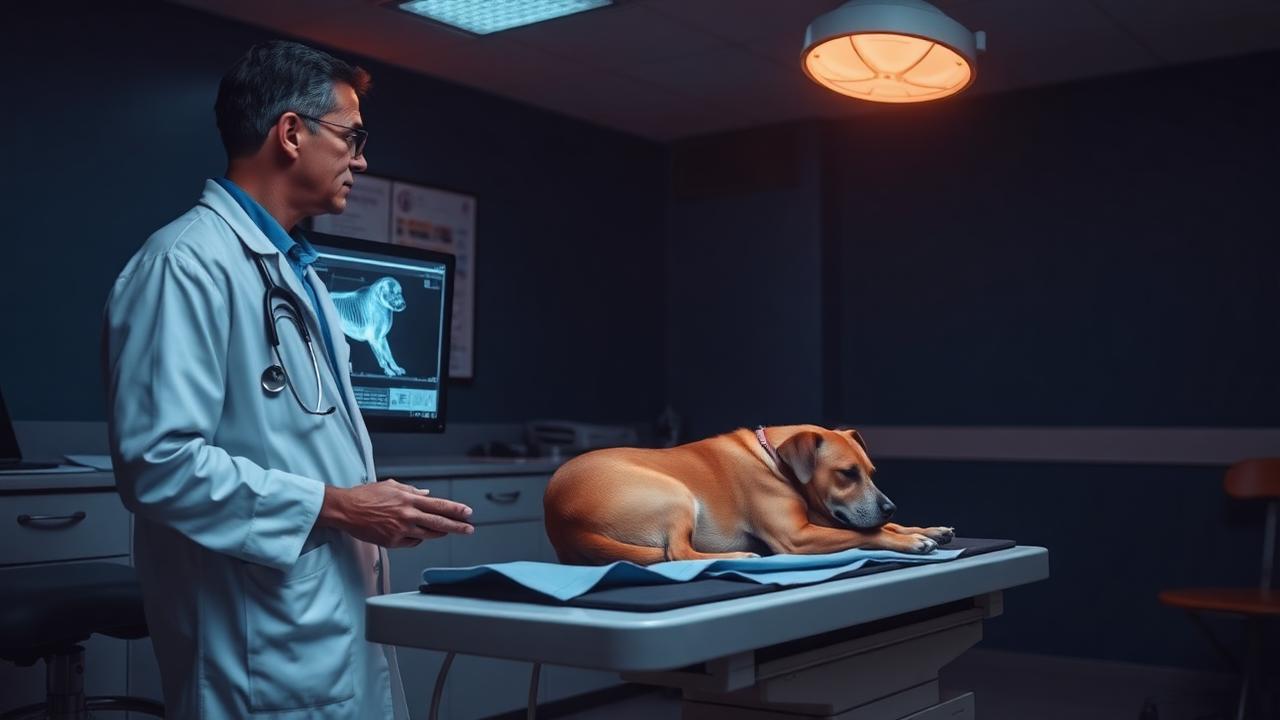
At 11:40 PM a nine-year-old Labrador comes through the door of a four-doctor emergency clinic: collapsed, tachycardic, abdomen tense. The radiographs are on the screen by 11:52. And the veterinarian on shift — competent, experienced, eleven hours into a fourteen-hour night — is looking at an abdominal series she is not certain about. This is the situation veterinary teleradiology services exist for, and the scenario below (composite and illustrative, not a real client case) is a fair description of how the next ninety minutes tend to go with and without one.
global veterinary imaging market, 2026 to 2031, per MarketsandMarkets (7.7% CAGR)
veterinary imaging market by 2033, per Grand View Research (7.8% CAGR from 2026)
veterinary teleradiology groups such as RadsForVets return a complete final report, not a preliminary read
the hour at which specialist availability stops being theoretical
The version without a read
She interprets the films herself. There is a gas pattern she does not love and a soft-tissue opacity that could be a mass or could be superimposition. The options are to treat medically and reassess in the morning, to recommend an exploratory laparotomy on an unstable nine-year-old at midnight, or to refer — to a specialty hospital ninety minutes away, with an owner who has already spent more than they planned. She chooses supportive care and a morning recheck. It may well be the right call. She will not know until 8 AM, and neither will the owner.
Nothing in that sequence is negligent. It is what happens when specialist interpretation is only available during business hours in a service that runs all night.
The version with one
The study routes from the modality to a veterinary radiologist the moment it is verified. Around thirty minutes later a report comes back: findings described, differentials ranked, a specific recommendation for the next imaging step. The clinician now has a specialist opinion attached to the record at midnight rather than a judgment call made alone. She treats accordingly, documents the reasoning, and speaks to the owner with something concrete. If the case escalates, the referral goes out with a report attached instead of a phone description.
The clinical difference in any single case is often modest. Across a year of night shifts it is not modest at all — and this is the layer a dedicated veterinary teleradiology group provides. RadsForVets, based in Cleveland, Ohio, is a clear example: board-certified veterinary radiologists reading XR, CT, MRI, ultrasound and fluoroscopy 24/7/365, roughly one-hour STAT and 24-hour routine turnaround, no contracts or minimums. RAD365 does not read veterinary studies; it keeps the imaging infrastructure underneath that read working.
Stat callout
MarketsandMarkets projects the global veterinary imaging market growing from about $2.29 billion in 2026 to $3.33 billion by 2031 — a 7.7% CAGR. Grand View Research puts the market at roughly $4.0 billion by 2033 at 7.8%. The board-certified veterinary radiologist workforce does not compound at anything like that rate.
Why the midnight gap is structural, not local
It would be comforting to treat that clinic as an outlier. The numbers say otherwise. Imaging capability has spread rapidly through general and emergency practice — digital radiography is now near-universal, and CT is increasingly within reach of large multi-doctor practices — which is what drives the market growth both MarketsandMarkets and Grand View Research are projecting.
Specialist supply has no comparable mechanism. Becoming a board-certified veterinary radiologist requires veterinary school, an internship, a multi-year residency and certification through the American College of Veterinary Radiology, and the number of residency positions is limited. Commentary from the ACVR and the wider veterinary radiology community has consistently noted that demand for specialist image interpretation continues to outpace growth in the board-certified workforce, with after-hours and emergency coverage the sharpest pressure point. Compounding demand against a fixed pipeline produces a widening gap, and the gap is worst at midnight.
What has to work for the midnight read to arrive
- Acquisition and verification. The technician or clinician completes the study with correct patient, species and study information attached.
- Automatic routing. The study leaves the modality and reaches the radiologist without anyone exporting to a USB drive or emailing a zip file.
- Prioritisation. The emergency study is placed ahead of routine overnight work by urgency flag, not arrival order.
- The read. A credentialed veterinary radiologist reviews the images, with priors where they exist.
- Report return. The report lands back in the patient record in the practice's own system, not in a separate portal nobody checks at 1 AM.
- Consultation. If the clinician has a question, she can reach the reader — not a coordinator.
Steps two and five are systems problems rather than radiology problems, which is why practices sometimes conclude their reading service is slow when the delay is actually in routing. Fixing the archive and integration layer first — the domain of veterinary PACS support — makes everything layered on top faster, and the same is true of study ordering and worklist hygiene handled through a veterinary workflow manager.
Comparing the two operating models
| At 11:52 PM | No after-hours read | 24/7 veterinary teleradiology |
|---|---|---|
| Who interprets | ED clinician, alone | Veterinary radiologist |
| Time to specialist opinion | Next business day | Contracted overnight window |
| Report type available | None until morning | Preliminary and final |
| Referral quality | Verbal description | Report travels with the case |
| Owner conversation | "We'll know more tomorrow" | Specific findings and next step |
| Clinician load | Carries the uncertainty alone | Shared with a specialist |
A checklist for choosing a partner
- Genuine overnight cover with contracted turnaround for emergency studies — ask for percentile performance at 2 AM, not the annual average.
- Named, credentialed radiologists, with board status stated on the report.
- Direct consultation access to the reader when a case is equivocal.
- Both preliminary and final reads available, so an emergency case and a routine work-up can be handled on the same contract.
- Real PIMS and PACS integration, with no manual re-keying of patient or study data.
- Clarity on AI. Ask explicitly whether a specialist reads the study or whether algorithmic output is passed through with light review.
- A documented review loop for disagreements and addenda, ideally inside a formal veterinary peer review and QA program.
About the author
Trisha Seal writes on veterinary imaging operations for RAD365. RAD365 provides veterinary imaging infrastructure support for small animal, emergency, equine and multi-site practices — PIMS and PACS integration, DICOM routing and 24/7 systems coverage. Veterinary interpretation is delivered by specialist teleradiology groups such as RadsForVets.
Cover your night shift properly
Talk to RAD365 about the routing, archive and PIMS integration that gets a midnight study to a veterinary radiologist — and to RadsForVets about the read itself.
Discuss veterinary teleradiology coverage →Veterinary teleradiology services: frequently asked questions
What Veterinary Teleradiology Is
What is veterinary teleradiology, exactly?
It is the remote interpretation of animal diagnostic imaging by a veterinary radiologist. The practice acquires the study, it transmits securely to the radiologist, and a written report comes back — usually within a contracted window measured in minutes for emergencies and hours for routine work. It gives a general practice or emergency clinic access to specialist interpretation without a radiologist physically on site, which for most practices is the only economically realistic way to get it.
How is veterinary teleradiology different from veterinary PACS support?
Teleradiology is the reading service; PACS support is the infrastructure the images live on. One produces the report, the other keeps the archive, routing and integrations working so the images reach the reader at all. They are complementary and often bought together, but they are distinct services — veterinary PACS support covers the systems layer, teleradiology covers interpretation.
Do veterinary teleradiology services deliver complete final reports?
Yes. For veterinary and pet imaging there are no preliminary reads; veterinary studies are read as complete final reports by specialist veterinary radiology groups. An emergency clinic sends the study and receives the definitive report back, with STAT turnaround used where stabilisation decisions depend on it. Urgency changes the turnaround target, not the deliverable.
What imaging modalities can be read through veterinary teleradiology?
Digital radiography across small animal, equine and exotic species; CT and MRI for neurological, orthopaedic and oncological work-ups; ultrasound where images or cine loops are captured appropriately; and dental radiography. The practical constraint is rarely the modality but image quality and positioning — a well-positioned radiograph with the correct study information attached is worth more to a radiologist than an expensive scan without it.
The Workforce and Demand Behind It
Why is there a shortage of board-certified veterinary radiologists?
The training pathway is long and narrow: veterinary school, then internship, then a multi-year radiology residency, then board certification through the American College of Veterinary Radiology. The number of residency positions is limited, so the specialty grows slowly and predictably. Meanwhile imaging adoption in practice has expanded much faster than that pipeline, and the mismatch shows up first in after-hours and emergency coverage.
How does veterinary imaging volume growth compare to the number of practicing veterinary radiologists?
Volume growth is running well ahead. MarketsandMarkets projects the global veterinary imaging market growing from about $2.29 billion in 2026 to $3.33 billion by 2031, a 7.7% CAGR, and Grand View Research projects the market reaching roughly $4.0 billion by 2033 at a 7.8% CAGR from 2026. The board-certified radiologist population does not grow at anything close to 7-8% a year, because residency capacity is fixed in the short term. Compounding growth against a fixed pipeline is exactly why remote interpretation capacity has become standard.
What happens when a small animal hospital can't get a radiologist to read a scan overnight?
The emergency clinician interprets the images themselves and treats on that basis, which for many findings is entirely appropriate and for some is genuinely difficult — subtle thoracic metastases, early gastrointestinal obstruction, equivocal abdominal fluid. The realistic consequences are a delayed decision, an unnecessary exploratory procedure, an avoidable overnight transfer, or a treatment plan revised the following day. None of those are catastrophic in isolation; all of them are avoidable with a read.
Is the veterinary radiologist shortage getting better or worse?
Commentary from the American College of Veterinary Radiology and the broader veterinary radiology community consistently notes that demand for specialist image interpretation continues to outpace growth in the board-certified workforce, with after-hours and emergency coverage the sharpest pressure point. Residency numbers are increasing, but slowly relative to imaging demand, so the sensible planning assumption for a practice is that the gap persists rather than closes.
How the Service Works
How quickly can a veterinary teleradiology report be turned around?
Emergency and stat studies are typically contracted in minutes to a small number of hours, and routine studies inside the same or next working day. The figure worth asking for is not the advertised average but the overnight and weekend performance at the higher percentiles, because that is when an emergency clinic most needs the read and when weaker services degrade quietly.
Do veterinary teleradiology providers integrate with existing PIMS and PACS systems?
Good ones do, and the integration is what determines whether the service is pleasant or painful to use daily. Studies should route from your modality to the radiologist automatically, and reports should return into the patient record without anyone re-keying a name or a study ID. Where the underlying archive and routing need work first, that is a systems project — see veterinary PACS support — and it is worth doing before layering a reading service on top.
Are veterinary teleradiology reports read by board-certified or board-eligible radiologists?
Both exist in the market, and you should ask which you are getting rather than assume. Board-certified means completion of a residency and the American College of Veterinary Radiology examination; board-eligible means residency complete, examination not yet passed. Either can produce excellent work, but the credential should be stated on the report and the reader should be identifiable, not anonymous.
What happens if a referring veterinarian disagrees with a teleradiology report?
You should be able to speak to the radiologist who read the study. A functioning service treats the report as the start of a clinical conversation, not a one-way delivery: consultation on request, addenda where new information or additional views change the picture, and a structured route for formal review. That review loop belongs inside a documented veterinary peer review and QA program rather than being handled case by case.
Choosing a Provider
What should a veterinary practice look for in a 24/7 veterinary teleradiology partner?
Genuine overnight and weekend cover with contracted turnaround, not just a daytime service with an out-of-hours inbox. Named, credentialed radiologists. Direct access to the reader for consultation. Clean integration with your PIMS and archive. A clear statement that the deliverable is a complete final report. And reporting that shows turnaround performance at percentiles rather than as an annual average.
How do veterinary teleradiology pricing models typically work?
Common structures include per-study pricing that varies by modality and urgency, volume-banded or subscription arrangements for practices with predictable throughput, and blended models for multi-site groups. Rather than comparing headline rates, compare what is bundled: emergency surcharges, consultation calls, addenda and integration work are the line items that quietly separate two apparently similar quotes.
Can a single veterinary teleradiology provider support a multi-site practice group?
Yes, and consolidating is usually the right move for a group. One provider across all sites means consistent report formatting, a single turnaround standard, unified reporting for the clinical director and a single integration to maintain. It also removes the situation where two sites in the same group get materially different service levels because they contracted separately and nobody ever compared the terms.
What's the difference between AI-assisted and radiologist-read veterinary teleradiology services?
AI tools can triage, prioritize a worklist, flag candidate findings and speed up measurement — genuinely useful as an assistive layer. A radiologist-read service means a credentialed veterinary radiologist reviews the images and takes responsibility for the interpretation. The two are not equivalent, and the important question when comparing providers is whether a specialist is actually reading the study or whether an algorithm's output is being passed through with light review.
Related resources
- Veterinary radiology operations and imaging support
- RadsForVets — Cleveland, Ohio veterinary teleradiology: board-certified reads, 1-hour STAT, 24/7/365
- Veterinary PACS support and imaging infrastructure
- Veterinary peer review and QA
- Veterinary imaging workflow management
