The Hidden Step Before Your Radiology Report Is Ever Finalized
Before any radiology report is finalized, a preliminary read often happens first. Here's what it is, why it exists, and what it isn't.
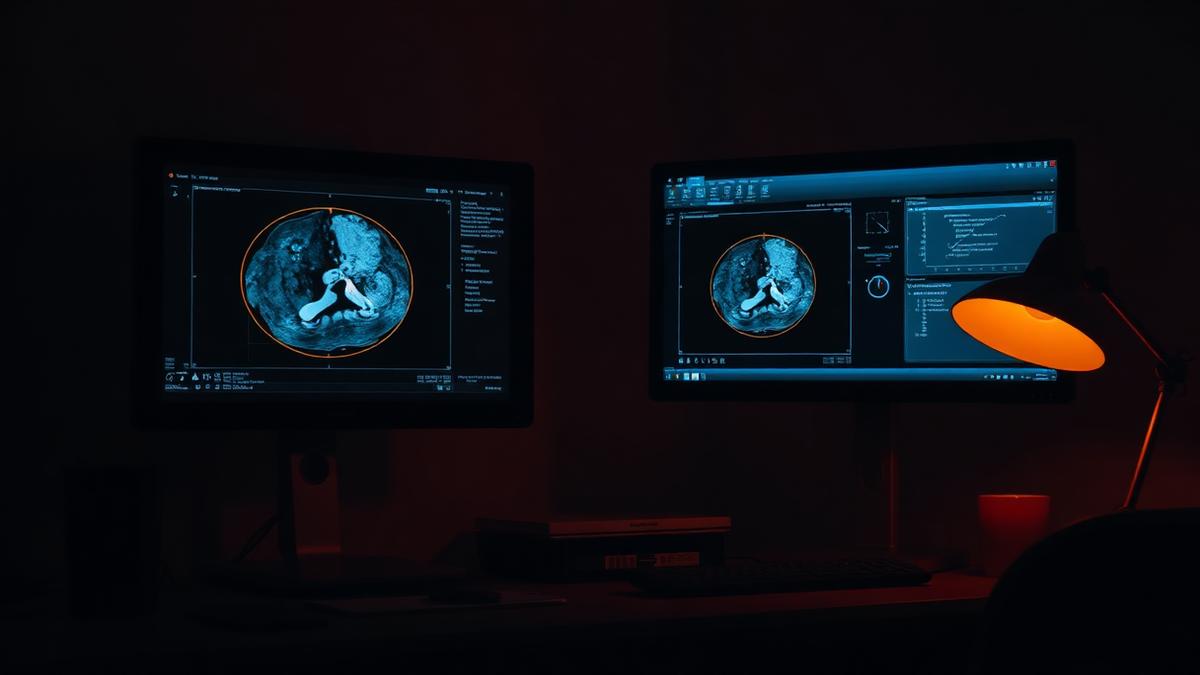
Here is something most people never learn about the scan they had at 11 PM: it was probably read twice. Once within the hour, quickly, by someone whose impression will never appear in the medical record — and again the next morning, properly, by the radiologist whose signature actually counts. Preliminary reads are the first of those two passes, and they are the reason a treating clinician can act on an emergency CT long before the official report exists.
⚠️ Important scope note — please read before continuing
For human facilities in the USA, RAD365 provides preliminary reads only — rapid after-hours, overflow and backlog interpretations that support an immediate clinical decision. The pre-read tells the treating clinician what appears to be there right now. RAD365 does not provide final reads for human patients; the facility's own licensed radiologist still completes and signs the final interpretation afterwards.
Veterinary imaging has no preliminary stage at all. The veterinary equivalent is simply a final report, delivered once, by specialist veterinary radiology groups.
By Trisha Seal — August 31, 2026. Trisha covers RAD365's offshore preliminary-read operation, where non-final interpretations are delivered inside a US facility's existing PACS worklist, under the facility's own radiologist sign-off.
The step is genuinely hidden. It rarely appears in patient-facing material, it does not show up on the bill as its own line, and the document it produces is deliberately superseded. But it is doing a large amount of the work in modern imaging departments, and the reason it exists has less to do with technology than with who is available to read at three in the morning.
Higher workforce exit likelihood for subspecialty vs. general radiologists (2026 ACR Bulletin / Neiman HPI)
US pediatric radiologists, 2016 to 2023 (2026 ACR Bulletin / Neiman HPI)
Pediatric radiologists as a share of all practicing radiologists, 2016 to 2023
Rate at which radiologists now leave practice entirely vs. under 10 years ago
What the first read actually is
A preliminary read is a rapid, non-final interpretation issued so a clinical decision can be made immediately. It tells the treating clinician what appears to be there right now — bleed or no bleed, obstruction or no obstruction, something requiring transfer or something that can wait for daylight. It is a workflow step, not a diagnosis of record.
The distinction is not a technicality. The facility's own licensed radiologist completes and signs the final interpretation afterwards, with priors, the full clinical picture, and the time to be thorough. That signed report is what enters the chart and supports the claim. The preliminary sits behind it as documentation and as a quality comparison point — which is why facilities that run a preliminary layer almost always run structured peer review and QA alongside it, sampling prelim-versus-final pairs rather than hoping the delta is small.
Preliminary Reads vs. Preliminary Reporting: Same Idea, Different Vocabulary
Buyers researching this category run into two phrases that sound like different products and are not. Preliminary reads is the operational noun — the studies themselves, the volume, the thing a coverage contract is measured in. Preliminary reporting is the process noun — the workflow, the documentation standard, the escalation policy, the turnaround discipline around producing those reads.
In practice, a department head says "we need preliminary reads overnight" when talking about capacity, and "our preliminary reporting is inconsistent" when talking about process. A vendor page that uses the phrases interchangeably is not wrong, but a contract that does is a problem: coverage volume and reporting standard need to be specified separately, because a provider can hit the first while failing the second. If you are scoping either, the preliminary reads service overview sets out what belongs in each half.
| Attribute | Preliminary read (human, USA) | Final interpretation (human, USA) | Veterinary report |
|---|---|---|---|
| Purpose | Support an immediate decision | Establish the diagnosis of record | Complete diagnostic report |
| Who produces it | Preliminary-read team (may be offshore) | Facility's own licensed radiologist | Specialist veterinary radiology group |
| Enters the medical record | No — workflow documentation | Yes | Yes |
| Typical clock | Minutes for emergent studies | Next business cycle | Agreed turnaround, single delivery |
| Number of stages | First of two | Second of two | One — there is no preliminary stage |
Why the category exists now, in numbers
The honest explanation is workforce arithmetic rather than any single dramatic shortage. A 2026 ACR Bulletin workforce update citing Harvey L. Neiman Health Policy Institute (HPI) research found that subspecialty radiologists are 37% more likely to exit the workforce than general radiologists. The same update documented pediatric radiology shrinking in absolute terms: from 2,190 pediatric radiologists in 2016 to 2,032 in 2023, falling from 6.4% to 4.6% of all practicing radiologists. And across the profession, the report found radiologists are now leaving practice entirely at more than twice the rate they were less than ten years ago.
None of that proves any individual hospital cannot staff its nights. These are attrition and workforce-composition figures, not a causal claim about a specific department. But they describe a bench that is thinner and less predictable than the one most rotas were originally designed around — particularly where subspecialty depth is assumed to be available on demand. A distinct, purchasable preliminary layer is the operational answer that emerged, and it is why the category stopped being an emergency measure and became a standing line item.
The step-by-step: what actually happens between scan and signature
- Acquisition. The study is completed and pushed to the facility's PACS through the existing DICOM pathway.
- Routing. Eligible studies — typically after-hours, overflow, or backlog — appear on the preliminary-read worklist. No separate viewer, no parallel archive.
- Preliminary interpretation. A radiologist reads for decision-relevant findings and issues the impression, time-stamped.
- Critical-findings escalation. Anything urgent goes to the treating clinician by direct voice contact, logged with time and name — not left as a flag in a queue.
- Clinical action. The treating team admits, transfers, operates, or discharges on the strength of that impression.
- Final interpretation. The facility's own licensed radiologist reads independently with priors and full context, then completes and signs the final report.
- Quality comparison. Prelim and final are sampled as a pair, discrepancies categorized by clinical significance, results fed back to the reading team.
Step 2 is where most implementations succeed or fail. A preliminary service that requires its own viewer, its own archive, or a change to how studies are routed has quietly turned a staffing decision into a systems project. Coverage should attach to the environment a facility already runs — the same principle that governs how RAD365's wider human radiology services sit alongside existing infrastructure rather than displacing it.
What a preliminary read is not
It is not an additional review, because it precedes rather than reviews the final. It is not a cheaper substitute for a radiologist, because the final interpretation still has to happen and still has to be signed by the facility's own physician. It is not a billing event in its own right. And it is not a veterinary product — veterinary imaging has no preliminary stage at all, and the veterinary equivalent is simply a final report, delivered once.
Providers that blur any of those four lines are worth slowing down on. The scope statement is the cheapest diligence available: a partner that will write "preliminary only, facility signs the final" into the first page of the agreement has already told you most of what you need to know about how it operates. The RAD365 preliminary reads page states that boundary in the same words used here, deliberately.
Scoping overnight or overflow coverage?
Talk to RAD365 about preliminary-read coverage that runs inside your existing PACS, with your radiologists signing every final interpretation.
Discuss preliminary read coverage →Preliminary Reads: Frequently Asked Questions
What a Preliminary Read Actually Is
What is the difference between a preliminary report and a final report in radiology?
A preliminary report is a rapid, non-final impression issued to support a decision that cannot wait — admit, transfer, operate, discharge. A final report is the signed diagnosis of record produced by the facility's own licensed radiologist, and it is what enters the patient's chart and supports billing. The two documents answer different questions: the preliminary answers "what appears to be there right now," the final answers "what is the definitive interpretation." They are sequential steps, not competing opinions.
Is a wet read the same thing as a preliminary read?
Functionally, yes. "Wet read" survives from the era when film came out of the processor still wet and a radiologist glanced at it before it dried. "Preliminary read," "prelim," and "pre-read" all name the same non-final step in a modern PACS workflow. The vocabulary varies by department and generation; the deliverable — a documented, time-stamped impression that precedes the signed final — does not.
Does a preliminary read go into the patient's permanent medical record?
The signed final interpretation is the diagnosis of record. A preliminary read is retained as workflow documentation and is routinely compared against the final for quality purposes, but it is not the record entry and should never be presented to a patient or a payer as the final diagnosis. Facilities generally keep prelims discoverable and auditable precisely so discrepancy tracking is possible.
Is a preliminary read separately billable?
In the standard US arrangement, no. The professional component is billed against the final, signed interpretation produced by the facility's own licensed radiologist. A preliminary read is purchased as an operational service by the facility or the radiology group — it buys coverage and turnaround, not a separate claim line. Any provider implying a prelim generates its own reimbursement should be asked to explain that in writing.
Can a preliminary read be changed later?
It is expected to be reviewed. The final read is performed independently with the full clinical picture and prior studies, and where it differs, the final governs. Well-run programs treat the delta between prelim and final as a measured quality signal rather than an embarrassment — a discrepancy rate that is tracked, categorized by clinical significance, and fed back to the reading team.
Human vs. Veterinary Scope
Does RAD365 provide final reads for human patients?
No. For human facilities in the USA, RAD365 provides preliminary reads only. The facility's own licensed radiologist completes and signs every final interpretation. That boundary is deliberate and permanent: it keeps the diagnosis of record, the credentialing, and the clinical relationship with the ordering physician exactly where they already sit, while adding coverage in the hours where a facility does not have a reader available.
Why does the preliminary/final boundary exist at all?
Because licensure, credentialing and accountability for the diagnosis of record are attached to the facility and its radiologists. A preliminary layer is an operational service that supports a clinical decision in real time; the final interpretation is a regulated professional act performed by the facility's own physician. Keeping the two distinct is what lets a hospital add night and overflow capacity without altering who is accountable for the diagnosis.
Is there a preliminary read for veterinary imaging?
No. Veterinary imaging has no preliminary stage at all. The veterinary equivalent is simply a final report, delivered once, by specialist veterinary radiology groups. Anyone marketing "veterinary preliminary reads" is describing a workflow that does not exist in that setting — a vet practice buying imaging interpretation is buying a complete report, not a two-stage process.
Does the human/veterinary distinction change how a facility should evaluate a provider?
Yes, and it is a fast credibility test. A provider that blurs the two — offering human "final reads" through an offshore team, or a veterinary "prelim" tier — is describing a scope it should not be describing. Ask a prospective partner to state, in one sentence each, what it delivers for human studies and what it delivers for veterinary studies. Vagueness there tends to predict vagueness elsewhere in the contract.
How It Works Operationally
How fast should a preliminary read come back?
For an emergent study the working expectation in most US departments is measured in tens of minutes, not hours, with critical findings escalated by direct voice contact rather than a queued note. Overflow and backlog work sits on a looser clock. What matters when evaluating a provider is not the headline average but the 95th percentile and the behavior of the queue at 3 AM on a holiday weekend, when the average is least informative.
How are critical findings handled on a preliminary read?
By direct, documented contact with the treating clinician — a phone call, logged, with the time of contact and the name of the person reached, not a flag dropped into a worklist and left. Escalation policy should be written into the service agreement and should specify what happens when the first attempted contact fails. A prelim that identifies an urgent finding nobody read is operationally identical to no prelim at all.
Does a preliminary read service require new software or a PACS replacement?
It should not. A preliminary-read team works inside the systems the facility already runs, receiving studies through the existing DICOM pathway and returning the impression into the existing worklist. If a provider requires the facility to adopt its own viewer or archive as a condition of coverage, that is a procurement decision hiding inside a staffing decision. RAD365 works alongside the facility's existing PACS rather than replacing it.
Who actually performs the reads, and how are they credentialed?
Radiologists working in a dedicated preliminary-interpretation capacity, with credentials and qualifications the facility can inspect before go-live. A facility should expect named readers rather than an anonymous pool, documented coverage by hour rather than an assurance of "24/7," and a stated position on what happens when volume spikes beyond the planned rota.
How does preliminary reading interact with peer review and QA?
It creates a natural comparison point. Because every preliminary impression is followed by an independent final interpretation, the pair can be sampled and scored — which is why preliminary programs and structured peer review and QA tend to be built together. The comparison is only useful if someone owns it: a named reviewer, a sampling cadence, and a route for feeding findings back to the reading team.
Why This Category Exists Now
Why has a separate preliminary-read layer become a standing part of US radiology?
Because the bench of readers available to look at every study immediately is thinner than it was. A 2026 ACR Bulletin workforce update citing Harvey L. Neiman Health Policy Institute research found radiologists are now leaving practice entirely at more than twice the rate they were less than ten years ago. When exits accelerate, the constraint stops being total headcount and becomes coverage at specific hours — and a purchasable coverage layer is the response the market produced.
Is subspecialty coverage part of the same pressure?
It is a sharp version of it. The same 2026 ACR Bulletin/Neiman HPI update found subspecialty radiologists are 37% more likely to exit the workforce than general radiologists. That matters operationally because subspecialty depth is exactly what a hospital cannot conjure at 2 AM, and it is the capability most often assumed to be available when a rota is drawn up on paper.
Is any particular subspecialty visibly shrinking?
Pediatric radiology is the clearest documented example. According to the same 2026 ACR Bulletin/Neiman HPI research, the number of pediatric radiologists in the US fell from 2,190 in 2016 to 2,032 in 2023 — dropping from 6.4% to 4.6% of all practicing radiologists. These are workforce and attrition figures rather than a direct causal claim about any one department, but they describe the environment in which a distinct preliminary layer became normal rather than exceptional.
How should a facility evaluate a preliminary-read provider?
Read the scope statement first and check that it says preliminary only, in plain words. Then ask for turnaround measured at the 95th percentile, the written critical-findings escalation policy, the discrepancy-rate methodology, named readers with inspectable credentials, and confirmation that the service runs inside your existing PACS. A provider comfortable with all six answers in writing is describing an operation. One that answers only in averages and adjectives is describing a brochure.
Related Reading
- What RAD365 preliminary reads cover — scope, turnaround and escalation
- Questions to ask before you trust a preliminary read service
- The full timeline from scan to signed final report
- Offshore preliminary reporting for US facilities
- Radiology peer review and QA programs
- Human radiology services from RAD365
