Why Billing and Workflow Belong in the Same System, Not Two Separate Ones
Disconnected billing and case workflow drive real denial and reconciliation costs. Real data on why they should share one platform.
By Trisha Seal — September 18, 2026. Trisha writes on radiology operations for RAD365, which builds the workflow-orchestration layer only — case routing, scheduling and the connected accounting tools around them. RAD365 supports PACS infrastructure and workflow operations.
The Thursday Reconciliation
Picture a mid-size radiology group running four sites. Cases move through one system while money moves through another, and every Thursday, two billing staff members spend most of the day making the two agree. They pull a list of completed cases, pull a list of billed cases, and work down the difference: a study amended after the claim went out, a body part recorded one way in the worklist and another on the invoice, three cases that were completed on Friday evening and never crossed over at all. Nobody calls this radiology revenue cycle management, but that is exactly what it is — and it is being done by hand because the group's case data and its financial data live in two places.
The group is not badly run. This is the default outcome of buying systems in sequence, and the cost of it is measurable.
What the Denial Data Says About That Seam
Experian's 2025 State of Claims Report found that 41% of providers report at least one in ten claims is denied, and 54% say denials are increasing. More pointedly, 26% of providers attribute roughly 10% of their denials to inaccurate or incomplete data collected at patient intake—not to clinical coding judgment, but to information captured incorrectly or duplicated. Experian also found that about half of providers still review claims manually, and 68% say submitting clean claims is harder than it was a year ago.
Read that against the Thursday exercise and the mechanism is obvious. Every re-keying step is a place for data to diverge, and every divergence is a candidate denial.
What the Administrative Cost Data Says
The CAQH Index puts the U.S. healthcare system's annual spend on routine administrative transactions — insurance verification and similar — at roughly $90 billion, with an estimated $20 billion in additional savings available simply by shifting remaining manual processes to electronic and automated workflows. CAQH also calculates that fully automated administrative workflows can save around 70 minutes per patient visit.
Seventy minutes per visit is not a rounding error at four sites. It is the Thursday reconciliation, distributed.
Step One: Find Out What the Seam Actually Costs
The group started by counting rather than theorizing: staff hours spent on reconciliation each week, the number of claims resubmitted after a data correction, and how many of those corrections traced back to a mismatch between the case record and the billing record rather than to a coding decision. That last number is the one that justifies a change, because it is the portion integration can actually remove.
Step Two: Separate Re-Keying Errors From Judgment Errors
Not every denial is addressable by architecture. Payer policy disputes, medical-necessity questions, and genuine coding calls require people. What integration removes is the category where the same fact was entered twice and the two entries disagree. Splitting the denial log along that line told the group how much of its problem was structural — and in their case, most of it was.
Step Three: Look at Where Case Data Already Lives
A radiology case carries the facts a claim is built from: modality, procedure, body part, site, date, referring source. Those are captured when the case is routed, long before anyone thinks about billing. If the workflow system that captures them also holds the price chart and the invoice, the claim is assembled from the original record instead of a copy of it.
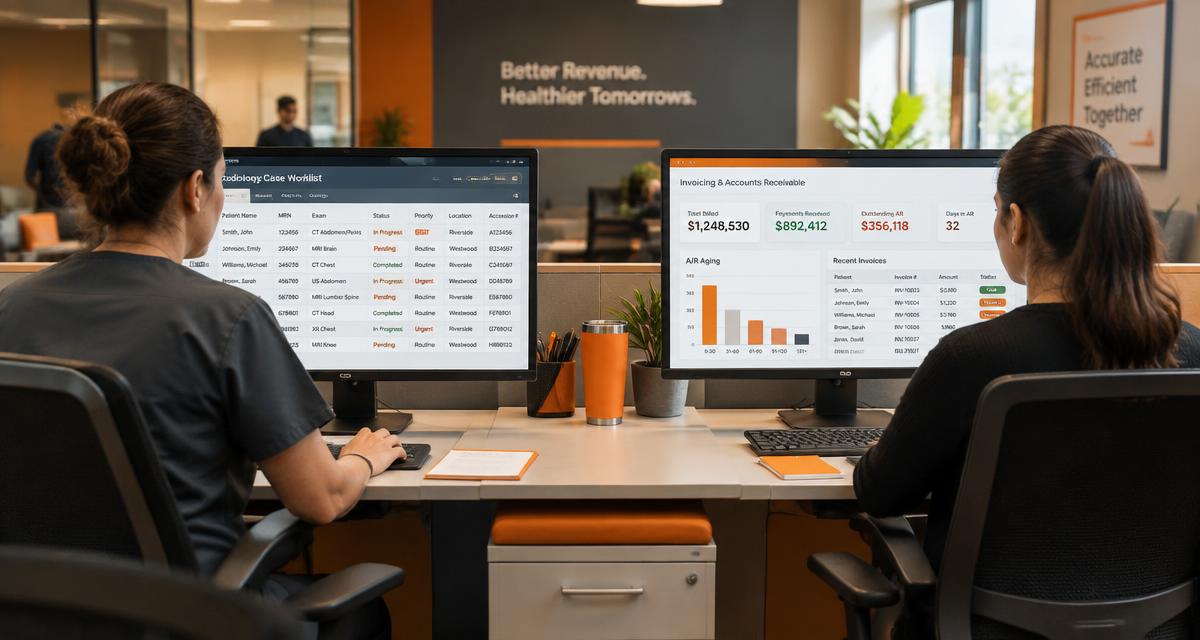
This is the architecture behind RAD365's Radiology Workflow Manager: case workflow and the accounting layer (price charts, payable charts, invoicing, accounts receivable and payable, aging analysis, and third-party integrations) sit inside a single connected system rather than two disconnected tools. It is one illustration of the structure, not the only possible one; the point is that the accounting layer is not a bolt-on. RAD365 supports PACS infrastructure and workflow operations.
Step Four: Watch the Aging Buckets, Not Just the Denial Count
Once the two records are the same record, aging analysis becomes genuinely diagnostic. A 61–90 day bucket that grows month over month stops being a mystery about slow payers and starts pointing at a specific upstream cause, because the case detail behind each balance is attached to it. Groups that also run a formal quality program keep that separate — peer review and QA is a clinical quality layer and has nothing to do with the financial record.
Two Models, Side by Side
| Aspect | Separate billing and workflow systems | One connected system |
|---|---|---|
| Data capture | Case detail entered, then re-entered for billing | Captured once at case level |
| Reconciliation | Recurring manual comparison of two lists | No second list to compare against |
| Amended cases | Billing record can lag or miss the change | Change carries through immediately |
| Denial investigation | Trace across two systems | Case and financial detail in one place |
| Aging analysis | Balances without case context | Balances linked to case detail |
| Staff time | Weighted toward matching records | Weighted toward denial prevention |
What This Does Not Solve
Integration does not negotiate with payers, appeal a denial or make a coding decision. The group still needs its billing team; what changed is that the team spends Thursdays on denial prevention instead of list-matching. One boundary is worth stating plainly: a workflow platform orchestrates cases and their surrounding administrative layer. clinical documentation stays with radiologists. Departments whose underlying imaging systems are the constraint are solving a different problem — that is managed PACS services and the support framework behind it, not a billing question.
See Case Workflow and Accounting in One Place
Bring your current reconciliation process and we will walk through how case routing, invoicing, receivables and aging analysis sit inside a single system. Workflow orchestration only.
Explore the Radiology Workflow Manager →Frequently Asked Questions
Why Billing and Workflow Drift Apart
Why do radiology departments end up running separate systems for billing and case workflow in the first place?
Usually by sequence rather than by decision. A group buys or inherits a worklist and reporting workflow to move cases, then adopts a billing system later — often at a different site, at a different time, or through a practice acquisition. Each system works on its own terms, so nobody replaces either one. The seam between them becomes a manual reconciliation habit that outlives everyone who remembers why it started.
What are the six stages of the healthcare revenue cycle, and where does radiology workflow intersect with them?
The cycle is generally described as patient registration and intake, insurance eligibility verification, charge capture and coding, claim submission, payment posting and remittance, then denial management and collections. Radiology workflow intersects most sharply at charge capture: the modality, procedure and body part recorded against a case are what the claim is built from. If the case record and the billing record are maintained separately, that intersection is where the two drift.
What is radiology revenue cycle management, exactly?
Radiology revenue cycle management is the end-to-end administrative and financial process that turns a completed imaging study into collected payment — verification, coding, claim submission, payment posting, denial follow-up and receivables management. It is an operational discipline rather than a clinical one; it governs how accurately case information becomes claim information, not how studies are manage.
How common are claim denials in healthcare today?
They are common enough to represent a structural cost. Experian's 2025 State of Claims Report found that 41% of providers report at least 10% of their claims are denied, and 54% say overall denials are increasing. Providers also report the work is getting harder: 68% said submitting clean claims is more challenging than it was a year earlier.
Where the Costs Actually Show Up
Why do claim denial rates keep climbing instead of improving?
Payer requirements keep tightening while the submission process stays largely manual on the provider side. In Experian's 2025 report, 54% of providers said denials are rising and 68% said clean-claim submission had become more challenging over the previous year. When rules change faster than the data-capture process that feeds them, the error rate moves in one direction.
How much of claim denial risk comes from bad data at intake rather than from clinical coding itself?
A meaningful share. Experian's 2025 State of Claims Report found that 26% of providers attribute roughly 10% of their denials to inaccurate or incomplete data collected at patient intake. That matters operationally because intake data is the part of the chain a workflow system touches first — before coding, before submission, and long before anyone is investigating a denial.
Are most radiology practices still processing claims manually?
Manual review remains widespread across providers generally: Experian's 2025 report found about half of providers still review claims manually. In radiology specifically, the manual portion tends to concentrate in reconciliation — matching completed case records against billing records — rather than in the claim form itself.
What does the CAQH Index say about the cost of manual administrative healthcare transactions?
The CAQH Index estimates that the U.S. healthcare system spends roughly $90 billion a year on routine administrative transactions such as insurance verification. These are not clinical costs; they are the price of moving information between organizations that hold it in different places.
How much could healthcare organizations save by automating manual billing and administrative workflows?
CAQH estimates a further $20 billion in available savings from shifting remaining manual processes to electronic and automated workflows, and calculates that fully automated administrative workflows can save roughly 70 minutes per patient visit. The saving is time returned to staff, which is exactly the resource reconciliation work consumes.
What Changes When Billing and Workflow Share One System
What does it actually mean for billing and case workflow to "live in the same system"?
It means the case record and the financial record are the same record viewed from two angles, rather than two records kept in sync by hand. The modality, procedure and body part captured when a case is routed are the same values the price chart, invoice and receivable are built from. Nobody re-keys anything, and there is no window in which the two versions can disagree.
How does connecting case data directly to billing reduce the kind of errors that cause denials?
It removes the re-entry step where transcription errors and omissions occur, and it removes the lag in which a case can be amended without the billing record following. Given that a quarter of providers trace roughly a tenth of denials to inaccurate or incomplete data capture, eliminating a duplicate capture point addresses the mechanism rather than the symptom.
Can an integrated system meaningfully cut the time staff spend reconciling case and billing records?
Yes, because reconciliation exists only to compare two copies of the same information. When there is one copy, the weekly exercise of matching completed cases against billed cases has nothing to compare. CAQH's estimate of roughly 70 minutes saved per patient visit under fully automated administrative workflows describes the same category of recovered time.
What is "aging analysis" in a radiology billing context, and why does it matter?
Aging analysis groups outstanding receivables by how long they have been unpaid — typically 0–30, 31–60, 61–90 and 90-plus days — so a group can see where collection risk is concentrating. It matters because recovery odds fall as balances age, and because a bucket that is growing usually points at a process problem upstream, such as a recurring denial reason, rather than at individual slow payers.
Does an integrated workflow-and-billing platform eliminate the need for a dedicated billing team?
No. It changes what that team spends its day on. Integration removes re-keying and reconciliation, which are low-value, high-error tasks; it does not remove payer negotiation, denial appeals, coding judgment or collections strategy. Groups that consolidate typically redeploy billing staff toward denial prevention and follow-up rather than reducing headcount.
Practical Considerations
What should a radiology group look for before consolidating billing and workflow onto one platform?
Check that the platform carries the accounting layer the group actually uses — price charts, payable charts, invoicing, accounts receivable and payable, receivables payment management, aging analysis and third-party account integration — and that it can connect to the systems already holding financial data. Deployment flexibility matters too: whether the platform can run in the cloud or on the institution's own intranet frequently decides what is feasible.
Does RAD365's Radiology Workflow Manager include billing and accounting functionality, or is that handled separately?
The Radiology Workflow Manager keeps case workflow and the accounting layer inside the same connected system: price charts, payable charts, invoicing, AR and AP, receivables payment management, aging analysis and third-party account integration sit alongside case routing and reporting workflow. RAD365 supports PACS infrastructure and workflow operations.
Is switching from separate billing and workflow systems disruptive to ongoing operations?
It is a scoped project rather than a switch thrown overnight. The usual approach maps existing case and financial data, runs both paths in parallel through at least one billing cycle so figures can be compared, then retires the manual reconciliation step once the numbers match. The disruption is concentrated in the mapping phase; the clinical workflow itself does not stop.
Related Services
- The Radiology Workflow Manager
- Radiology administrative support
- Revenue cycle operations
- Managed PACS services
- The PACS support framework
- Peer review and QA
Sources
- Experian Health, "2025 State of Claims Report" — healthcare claim denial statistics
- CAQH Index, "New CAQH Index Reveals $20B Savings Opportunity" — administrative transaction cost data
