Outsourced PACS Support vs. Hiring a PACS Administrator In-House
Compare outsourced PACS support with hiring a PACS administrator in-house: coverage hours, true cost, multi-vendor depth, SLAs and onboarding time.
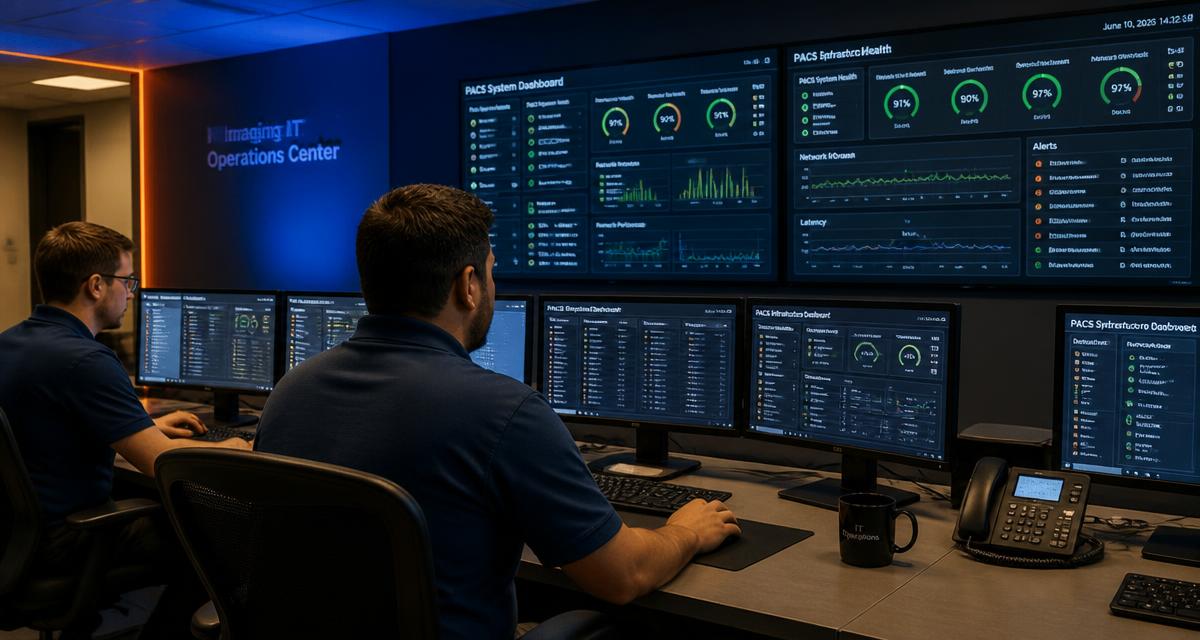
By Trisha Seal — September 16, 2026. RAD365 operates PACS environments for hospitals, imaging centers and critical access facilities as a full-time operations function: vendor-agnostic engineering coverage, severity-based SLAs, migrations and consolidations. RAD365 supports PACS infrastructure and workflow operations.
Sooner or later, every imaging department reaches the same fork in the road: post the job for a PACS administrator again, or hand the environment to an outsourced PACS support team. The two options look like variations on the same decision, but they buy very different things. Hiring buys one person's working week. Outsourcing buys a staffed rotation with contractual response times behind it. This guide compares the two models point by point, using the same criteria the comparison table on the RAD365 homepage uses.
Scope First: What Is Actually Being Compared
To keep the comparison honest, it helps to be precise about scope. RAD365 supports PACS infrastructure and workflow operations. What is being compared here is the systems and infrastructure layer — PACS administration, modality connectivity, DICOM and HL7 interface management, archive and storage administration, worklist configuration, vendor escalation and incident response. Clinical clinical documentation stays with your own radiologists in both models.
The Twelve Criteria That Actually Decide It
Most comparisons collapse into a single question about price. These twelve criteria are more useful, because each one maps to something that either happens or does not happen on a bad Saturday night.
| Criterion | Outsourced PACS support (RAD365) | Hiring a PACS administrator in-house |
|---|---|---|
| 24/7 coverage | Engineers on shift through nights, weekends and holidays | One person covering roughly a business-hours week |
| Response speed | Severity-based response times written into the contract | Depends on workload, availability and whether the person is off |
| Multi-PACS expertise | Team-wide experience spanning many vendor platforms at once | Limited to the systems that individual has personally worked on |
| Legacy or deprecated PACS | Keeping end-of-life systems stable is core work | Very difficult to recruit for; expertise is scarce |
| Consolidation and migration | Built into the operating model, with parallel running during transition | An extra project loaded onto an already full role |
| DICOM, HL7 and worklist depth | Dedicated imaging-integration engineers on the team | General IT staff often lack deep imaging-interface experience |
| Vacation, sick leave and turnover | No single-person dependency; knowledge stays with the team | One resignation can leave the environment unowned |
| Cost predictability | Flat monthly operations fee scoped to your environment | Salary, benefits, training, overtime, backfill, tooling and turnover |
| Upsell incentive | None — we operate the PACS you already own | None, but objective replacement guidance can be hard to source |
| Time to value | 2–4 weeks standard onboarding; under 1 week in an emergency | Recruiting, notice periods and ramp-up before full productivity |
| Scalability | Coverage scales as sites, modalities or PACS instances change | Adding headcount is slow and expensive |
| Accountability | One contract, one SLA, one team to hold to it | Managed internally through normal HR and performance cycles |
The first row settles more conversations than the rest combined. Business-hours coverage feels adequate right up until the archive fills at 11 p.m. on a holiday weekend, which is precisely the gap managed PACS services exist to close.
What "24/7" Has to Mean in Writing
A promise of round-the-clock support means nothing without a defined response time attached to it. RAD365 works to four severity tiers:
| Severity | Definition | Response commitment |
|---|---|---|
| Severity 1 | System down, clinical impact | 15-minute response, continuous work until resolved |
| Severity 2 | Degraded service | 1-hour response |
| Severity 3 | Single-user or non-urgent issue | 4-business-hour response |
| Severity 4 | Request or change | Next business day |
An internal administrator can commit to the same tiers verbally and mean every word of it. The difference is structural: a rotation can answer at 2 a.m. because someone is already awake and on shift. One person cannot, no matter how committed they are. A documented PACS support framework turns that structure into something a hospital can hold a provider to.
The True Cost of the In-House Option
Comparing a salary against a monthly fee understates the in-house side. A realistic internal cost includes benefits and payroll taxes, recruiting and agency fees, onboarding and vendor training, certifications, tooling and remote-access licenses, overtime or on-call premiums, and the cost of covering the role during leave and after a resignation. The outsourced side is a flat monthly operations fee scoped to your environment, which is why finance teams tend to find it easier to plan against.
Vendor Breadth: The Gap Hiring Cannot Close
A new hire's platform expertise is whatever they used at their last employer. An outsourced team's expertise spans the field: GE Centricity and Universal Viewer, Philips IntelliSpace, Sectra, Fujifilm Synapse, Agfa Enterprise Imaging, Change Healthcare/Stentor, Intelerad, Visage, Carestream Vue, eRAD, Novarad, RamSoft PowerServer, Merge Unity, and open-source or legacy stacks that many administrators have never touched. For a multi-site network running two or three platforms after an acquisition, that breadth is usually the deciding factor.
Critical Access and Rural Hospitals: A Different Calculation Entirely
For a large urban health system, hiring is at least possible. For a critical access or rural hospital, the local labor market frequently has no PACS-trained candidates at all. In that setting the comparison is not cheaper versus more expensive — it is coverage versus no coverage. Outsourcing delivers 24/7 engineering depth without the full-time payroll burden that rural facilities struggle to staff locally, even when budget is available.
How a Transition Actually Runs
Moving from an in-house arrangement to an outsourced one follows a predictable sequence. Discovery documents the environment, vendors, interfaces and current escalation paths. Access and monitoring are established. The incoming team runs alongside existing support so nothing is dropped mid-transition. Then support cuts over fully, with severity tiers and reporting in force from day one. Standard onboarding takes 2 to 4 weeks; where a hospital is already exposed, emergency onboarding compresses to under a week.
Where Peer Review Fits
PACS operations and clinical quality are separate layers, and they should stay separate. For human radiology groups that want a quality program alongside their imaging operations, peer review and QA is available as an optional add-on rather than something folded into the core support scope.
Run the Comparison Against Your Own Environment
Bring your site count, vendor mix and coverage hours, and we will show you where outsourcing beats hiring — and where it does not. Systems and infrastructure support only.
See the full comparison on rad365.com →Frequently Asked Questions
Comparing the Two Models
What's the real difference between outsourcing PACS support and hiring a PACS administrator?
Hiring gives you one person's calendar. Outsourcing gives you a team under a contract. The in-house model concentrates every skill, every password and every piece of institutional knowledge in one role that works business hours. The outsourced model spreads the same scope across a staffed rotation with written severity-based response commitments, so coverage does not depend on whether one individual is available.
Is it cheaper to hire one PACS administrator or outsource to a PACS support team?
The honest comparison is not salary against fee. An in-house hire carries salary plus benefits, recruiting, training, tooling, overtime for after-hours work and the cost of turnover. RAD365 works on a flat monthly operations fee scoped to your environment, so the budget line is predictable and already includes nights, weekends and holidays. Which one wins depends on your site count, vendor mix and how much after-hours coverage you actually need.
Can a single in-house PACS administrator realistically cover 24/7 support?
No. One person covers roughly a business-hours week. Genuine round-the-clock coverage requires a rotation, which means either several hires or an on-call arrangement that depends on somebody answering the phone at 2 a.m. after a full working day. A team model exists specifically because one calendar cannot cover 168 hours.
What happens to PACS support when the in-house administrator takes vacation or leaves?
With a sole administrator, any absence—whether planned vacation or an unexpected resignation—creates immediate operational risk until coverage is arranged or a replacement is hired. In an outsourced model there is no single-person dependency, because the documentation, access and escalation paths sit with the team rather than one individual.
Does outsourcing PACS support mean losing control over our imaging environment?
No. The hospital keeps ownership of its systems, its data and its decisions. RAD365 operates the environment you already own and has no incentive to sell you a replacement PACS. Change control, approvals and escalation thresholds are agreed with your team, and reporting gives you visibility into what was done and when.
Cost & Staffing Risk
What does a full-time PACS administrator actually cost beyond salary?
Beyond base salary, budget for benefits and payroll taxes, recruiting and agency fees, onboarding and ongoing vendor training, certification renewals, tooling and remote-access licenses, overtime or on-call premiums for after-hours incidents, and the cost of backfilling the role during leave or after a resignation. Those line items rarely appear in the original hiring business case.
How long does it typically take to hire and onboard a qualified PACS administrator?
PACS administration is a specialized role, so sourcing, interviewing, notice periods and environment-specific onboarding stack up quickly — and the new hire is not fully productive on day one. By comparison, standard onboarding with RAD365 takes two to four weeks, while emergency onboarding can be completed in less than a week if an administrator or vendor departs unexpectedly.
What happens to institutional PACS knowledge when a sole administrator resigns?
It usually walks out with them. Hanging protocol quirks, interface mappings, undocumented workarounds and vendor contacts often live in one person's head. An outsourced team documents the environment as part of onboarding, which means the knowledge survives any individual engineer's departure.
Coverage & Multi-PACS Environments
Can outsourced PACS support cover multiple PACS vendors at once?
Yes, and that is one of the clearest advantages over a single hire. RAD365 works vendor-agnostically across systems including GE Centricity and Universal Viewer, Philips IntelliSpace, Sectra, Fujifilm Synapse, Agfa Enterprise Imaging, Change Healthcare/Stentor, Intelerad, Visage, Carestream Vue, eRAD, Novarad, RamSoft PowerServer, Merge Unity, and open-source or legacy stacks — all under one set of SLAs.
How is a mixed PACS environment handled during consolidation?
Consolidation and migration support is part of the operating model rather than a separate project bolted onto an already stretched role. The practical approach is to keep the legacy and target systems running in parallel through the transition so clinical work continues, with validation of studies and metadata before the old environment is retired.
What if our hospital is on a legacy or vendor-abandoned PACS system?
Keeping end-of-life and deprecated systems stable is core work for RAD365, not an exception. That matters because the hiring market for expertise in an abandoned platform is effectively empty — the people who know those stacks are the ones who already operated them.
Do rural or Critical Access Hospitals face different PACS staffing challenges?
Yes. In many rural markets there is simply no local pool of PACS-trained candidates to recruit from, so "hire in-house" is not a cheaper alternative — it is often not an available one. Outsourced support gives a critical access facility 24/7 engineering coverage without carrying a 24/7 payroll burden it could not staff locally anyway.
Working With RAD365
Does RAD365 replace our internal IT team or work alongside it?
We work alongside it. Internal IT typically owns the network, endpoints and enterprise systems; RAD365 owns the imaging-specific layer — PACS administration, DICOM and HL7 interfaces, modality connectivity, archive management and vendor escalation. Escalation boundaries are agreed up front so nothing falls between the two teams.
What SLA commitments does RAD365 make compared to an internal team's informal response times?
RAD365 commits to written severity tiers: Severity 1 (system down with clinical impact) gets a 15-minute response and continuous work until it is resolved; Severity 2 (degraded service) gets a 1-hour response; Severity 3 (single-user or non-urgent issues) gets a 4-business-hour response; Severity 4 (requests and changes) is handled by the next business day. An internal team can intend the same thing, but intent is not a contractual commitment.
Is peer review and QA included, or is it separate?
Peer review and QA is available as an optional add-on layer for human radiology groups rather than being bundled into the core PACS operations scope. You can see how that layer works on the peer review and QA service page.
How fast can a hospital transition from in-house to RAD365's outsourced model?
Standard onboarding takes 2 to 4 weeks and covers discovery, documentation of the current environment and escalation protocols, and a period running alongside existing support before full cutover. When a hospital is exposed — for example an administrator leaving without notice — emergency onboarding can be completed in under a week.
Does outsourcing PACS support to RAD365 mean RAD365 case activity or manage our studies?
No. PACS support covers imaging systems and operational coordination. RAD365 supports PACS infrastructure and workflow operations. Our scope is the systems and infrastructure layer — keeping the PACS, interfaces and imaging workflow running — while all clinical clinical documentation remains entirely with your own radiologists.
What information does a hospital need for an accurate cost comparison?
Bring the number of sites and PACS instances, the vendors and versions in use, study volume and modality mix, current support contracts and their renewal dates, the coverage hours you actually need, and the fully loaded cost of any existing in-house imaging IT role. With that, the flat monthly fee can be compared directly against the true internal cost rather than against a salary figure alone.
