The 2 AM Scan: What a 'Pre-Read' Actually Is (and Isn't)
A 2 AM scan and an overloaded on-call radiologist: what a 'pre-read' actually is, how it works, and exactly where the line stops for human patients.
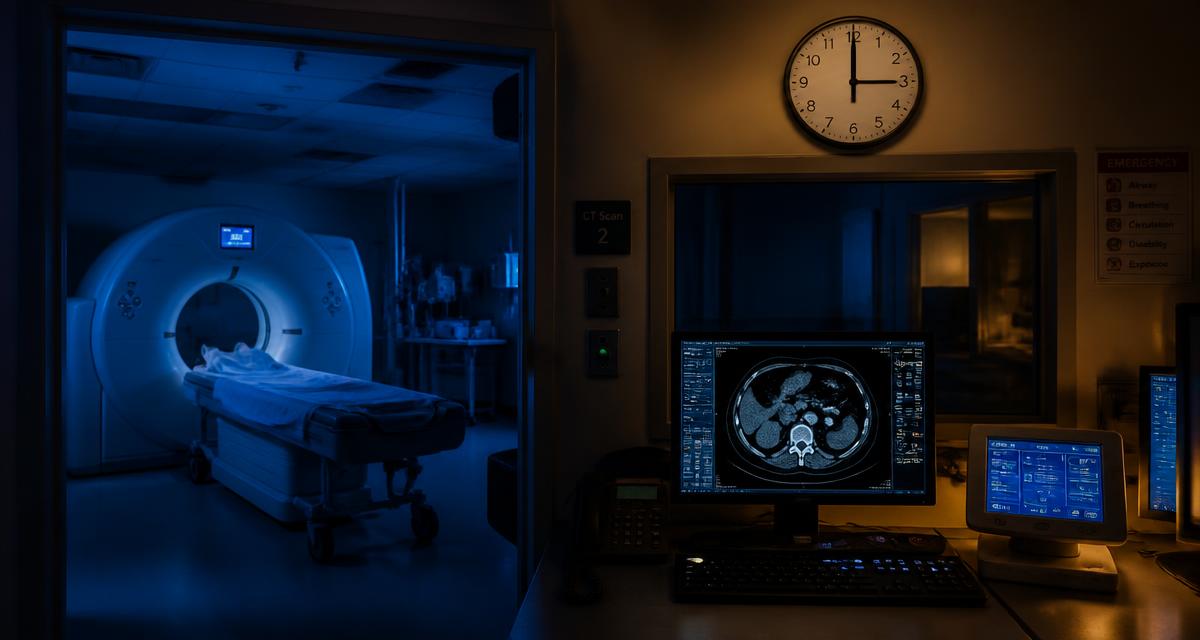
It is 2:06 in the morning. The ambulance bay doors have been open for four minutes. A 71-year-old man arrived with right-sided weakness and slurred speech that started, as best anyone can establish, somewhere around 1:40. He is on the CT table by 2:11. The last series reconstructs at 2:16.
And then the question every overnight team knows by heart: who is going to look at this, right now? The facility's own radiologist finished at six the previous evening and is asleep. The next scheduled shift starts at eight. Nobody involved in this patient's care can wait six hours to find out whether there is blood on that scan. What closes that gap is a pre-read — the shorthand the floor uses for a preliminary read, a fast interpretation issued ahead of the final signed report. This is what pre-reads actually are, in plain language, before anyone gets technical about them.
⚠️ Important scope note — please read before continuing
RAD365 provides offshore preliminary reads for human patients in the USA only — we do not provide final reads; your facility's own licensed radiologist completes every final interpretation. For veterinary and pet imaging there are no preliminary reads; veterinary studies are read as complete final reports by specialist veterinary radiology groups.
By Trisha Seal — September 15, 2026. RAD365 has run offshore preliminary read operations for 12+ years, working inside each client's own PACS worklist. That experience sits specifically in the preliminary read and offshore workflow layer — RAD365 does not sign final human reads, and every final interpretation is completed by the facility's own licensed radiologist.
What a Pre-Read Actually Is
A pre-read is a rapid, documented interpretation of an imaging study, produced by a radiologist and explicitly labeled as not final. It exists for one reason: a clinical decision has to be made before the facility's own radiologist can get to the study.
The vocabulary is informal. "Pre-read," "prelim," and "preliminary read" all describe the same thing, said with different degrees of hurry. None of these terms is a regulatory category in the way "final report" is. There is no federal definition of a pre-read, because a pre-read is not the interpretation that gets billed and it does not carry diagnostic responsibility. Both of those belong, without exception, to the signed final report produced by the facility's own licensed radiologist.
What a pre-read is in practice is a documented artifact: written, timestamped, attributed to a named radiologist, and returned into the facility's own imaging record. It can appear in the chart as a preliminary note, and it should — particularly where a critical finding was relayed, because the reasoning behind a 2 AM decision needs to be traceable later. But it does not stand in for the final. It is context, not conclusion.
How the 2 AM Read Actually Happens
Back to the CT that finished at 2:16. Here is the sequence, step by step.
1. The study lands on the existing PACS worklist. No export, no separate portal, no second archive. Routing rules inside the facility's own system decide which studies — by modality, priority flag, hour, or location — are visible to the covering team. The technologist who ran the scan changes nothing about how they work.
2. A radiologist reads it. Not an algorithm. AI tools increasingly sit in front of the worklist, flagging suspected intracranial hemorrhage or large-vessel occlusion so that study jumps the queue — and that triage genuinely matters at 2 AM. But the interpretation itself is produced by a qualified human radiologist looking at the images. AI changes which study gets opened first; it does not write the read.
3. A critical finding is relayed by protocol, with an audit trail. If there is blood, nobody leaves the result sitting on a worklist. Escalation is a direct human contact along a named path with named fallbacks, inside an agreed maximum interval, and the contact is logged with a timestamp. That log is not paperwork — it is the evidence that the communication happened.
4. The facility's own radiologist reads and signs the final. On their normal shift, with priors, with time, with the full clinical record. They are not countersigning someone else's work. They are producing the diagnostic interpretation of record, which is the one that is billed and the one that carries medico-legal weight.
That fourth step is not a formality, and it is not negotiable. Because the workflow runs inside the facility's existing systems, the practical integration question is a PACS and routing question rather than a clinical-systems replacement project. Where the underlying issue is departmental capacity rather than the overnight window specifically, that is a different conversation — one about human radiology services more broadly.
Why the Model Exists at All
The structural reason pre-reads keep growing is unglamorous arithmetic, and it is worth stating briefly rather than at length.
Projected US radiologist workforce growth, 2023–2055 (JACR / Neiman HPI)
Projected rise in baseline imaging demand by modality over the same period
Research published in the Journal of the American College of Radiology projects the US radiologist workforce growing roughly 25.7% between 2023 and 2055 if residency levels hold steady, while baseline imaging demand over the same period is projected to rise 16.9%–26.9% depending on modality — comparable growth rates that mean today's coverage gap is expected to persist rather than close on its own (source: JACR "Projected US Radiologist Supply, 2025 to 2055" and "Projected US Imaging Utilization, 2025 to 2055," as summarized by the Harvey L. Neiman Health Policy Institute).
Projected growth, US population aged 75–84, by 2055
Projected growth, US population aged 85–94, by 2055
Projected growth, US population aged 95+, by 2055
Radiographer vacancy rate, all-time high (Radiology Business, 2023)
Population aging is a major driver: research projects the US population aged 75–84, 85–94, and 95+ to grow by 51.5%, 149.6%, and 282.1%, respectively, by 2055. Older demographic groups generate higher imaging volumes per capita, pushing more routine and overflow cases into windows where preliminary coverage is required. The staffing side shows the same pressure: the 2023 Radiology Business national salary and job-satisfaction survey found radiographer vacancy rates at an all-time high of 18.1%, up from 6.2% two years earlier.
That is the whole of the structural argument, and it is deliberately short. Numbers explain why the model exists. They are not why the man on the table at 2:16 needs someone to look at his scan.
Preliminary Read vs. Final Read
| Dimension | Preliminary read (pre-read) | Final read |
|---|---|---|
| Who performs it | A named radiologist on the covering team, working inside your PACS under a provisioned account | Your facility's own licensed radiologist |
| Timing | Immediately, inside the decision window — overnight, weekend, or overflow | On the radiologist's normal shift, with priors and full clinical context |
| Billing status | Not separately billable to Medicare or insurers | The billable professional interpretation |
| Record status | Documented, timestamped, explicitly non-final; context in the record | The interpretation of record; carries medico-legal responsibility |
The two rows that settle most internal debates are billing and record status, because together they explain why a preliminary-only arrangement changes nothing about who owns the diagnosis. Facilities that log every preliminary-to-final discrepancy by modality and severity and route it through their existing peer review and QA program end up with an unusually useful quality data set — two independent reads of the same study, compared as a matter of routine.
Why Human and Veterinary Imaging Follow Different Rules
People who work across both sides of imaging often assume the preliminary/final split is a clinical convention. It is largely a billing and licensure one.
In US human healthcare, the professional component of an imaging study is billed against a signed final interpretation produced by a licensed radiologist working under the facility's credentialing. Everything issued before that — however careful, however useful — is by definition preliminary, because the entity that gets paid and the physician who carries the responsibility have to be the same signed document. That regulatory structure is what creates the space a pre-read occupies.
Veterinary imaging has no equivalent structure. There is no Medicare, no professional-component billing rule requiring a countersigned final from an on-site licensed reader, and therefore no gap between a fast read and an accountable read that needs bridging. So the workflow doesn't create one. Veterinary studies go straight to a complete final report from a specialist veterinary radiology group — no preliminary stage at any point. Same imaging, same modalities, entirely different reporting model, for reasons that are administrative rather than clinical.
Back to 2:16 AM
The CT lands on the worklist at 2:17. It is opened at 2:23. There is no hemorrhage — which, for a stroke alert, is the answer that unlocks the next decision rather than closing the case. The covering radiologist dictates a preliminary interpretation, timestamped and labeled non-final, and picks up the phone to the emergency physician because the protocol says a stroke-alert result is relayed by voice, not left in a queue. That call is logged at 2:29.
The patient goes to thrombolysis. At 8:40 that morning, the facility's own radiologist opens the same study, reads it in full against priors, and signs the final report. It agrees with the preliminary. It is the interpretation that enters the record and the one that is billed.
Nobody in that chain mistook one for the other, and that is the entire point. A pre-read is not a lesser final report. It is a different instrument, doing a narrower job, in a window where the alternative is not a better read — it is no read at all until morning.
Frequently Asked Questions About Pre-Reads
What "Pre-Reads" Actually Means
Why do people shorten "preliminary read" to "pre-read"?
It's simply faster to say in a fast-moving clinical setting. "Pre-read" and "prelim" are the shorthand radiology staff and ER teams use on the floor; "preliminary read" is the fuller, more formal version used in documentation and contracts. Both refer to the same thing: a rapid interpretation issued ahead of the final, signed report.
Is "pre-read" an official radiology term or informal shorthand?
It's informal shorthand that has become industry-standard usage. There's no single regulatory body that defines "pre-read" as a formal category the way "final report" is defined for billing purposes — it's a working term for the rapid interpretation that supports care before the licensed radiologist's signed final is complete.
Do pre-reads show up anywhere in the official medical record?
They can appear as a preliminary note or a documented communication, particularly when a critical finding is relayed, but the pre-read itself is not the billable or legally final interpretation. The signed final report from the facility's own licensed radiologist is what becomes the official interpretation of record.
Is a pre-read considered a diagnosis?
No. A pre-read supports an immediate clinical decision — whether to admit, transfer, or begin treatment — but it is not a diagnosis in the legal or billing sense. The diagnostic interpretation of record is the signed final report from the patient's own facility radiologist.
Is a pre-read the same thing as a "wet read"?
They describe the same moment in the workflow, but not the same artifact. "Wet read" is film-era language for a quick verbal impression given on the spot, and what it usually means today is informal and unwritten. A pre-read in a modern workflow is documented: written, timestamped, attributed to a named radiologist, and stored alongside the study in the facility's own imaging record, with an agreed escalation protocol behind it. The practical difference is auditability — a wet read lives in someone's memory of a hallway conversation, while a pre-read can be retrieved months later and compared against the final.
How a Pre-Read Happens, Step by Step
How fast does a pre-read typically come back after a scan is taken?
Turnaround targets are set per facility based on case mix and urgency tier, but the entire premise of a pre-read is speed — getting a working interpretation back fast enough to inform a treatment decision that can't wait for the on-call radiologist to become available, whether that's minutes for a STAT trauma case or a longer window for routine backlog.
Who is actually looking at the scan during a pre-read — a machine or a person?
A person. AI tools are increasingly used to triage and flag studies for priority review, but the pre-read interpretation itself is produced by a qualified radiologist reviewing the images, not generated automatically. AI assistance speeds up which study gets looked at first — it doesn't replace the read.
Does the treating physician wait for the pre-read before treating the patient?
In genuine emergencies, clinical judgment and other diagnostic information often drive immediate treatment regardless of imaging status. The pre-read exists specifically to close the gap for cases where imaging materially changes the treatment decision and the facility's own radiologist isn't immediately available to weigh in.
Can a pre-read be issued for a routine backlog case, not just an emergency?
Yes. Pre-reads apply to both scenarios — the true after-hours emergency and the more mundane problem of routine daily volume outpacing how fast a facility's own radiologists can work through the worklist. Backlog clearance is one of the most common uses precisely because it isn't dramatic; it's just volume.
Human vs. Veterinary, and Who's Accountable
Why don't veterinary scans get a "pre-read" the way human scans do?
Veterinary imaging in this model skips the preliminary stage entirely and goes straight to a complete final report from a specialist veterinary radiology group. There's no regulatory framework requiring a licensed on-site veterinary radiologist to countersign a final the way there is for human Medicare billing, so the workflow that creates the need for an interim "preliminary" layer in human care doesn't apply the same way on the veterinary side.
If pre-reads aren't the official final answer, why do facilities rely on them at all?
Because the alternative is a clinical decision made with less information, not more caution. A pre-read gives the treating team a working interpretation immediately rather than making them wait hours for the facility's own radiologist to be available — while the accountable, billable final interpretation still comes from that licensed radiologist on their normal schedule.
Could a facility just skip pre-reads and wait for the radiologist to be available?
Some do, particularly low-volume facilities without meaningful after-hours imaging demand. But for any facility running real overnight, weekend, or overflow volume, waiting means slower treatment decisions and a growing backlog — which is exactly the gap pre-reads are built to close.
Who is accountable if a treatment decision is made based on a pre-read alone?
The facility's own clinical protocols govern how a pre-read is used in the moment, and the facility's own licensed radiologist remains accountable for the signed final interpretation that becomes part of the permanent record. A reputable pre-read partner documents every read, every relay of a critical finding, and every discrepancy between the preliminary and final for exactly this reason.
Why the Pre-Reads Model Keeps Growing
Is the growth of pre-reads connected to the radiologist shortage?
It's one factor among several. Research published in the Journal of the American College of Radiology projects the US radiologist workforce growing roughly 25.7% between 2023 and 2055 if residency levels hold steady, while baseline imaging demand over the same period is projected to rise 16.9%–26.9% depending on modality, per the same body of research as summarized by the Harvey L. Neiman Health Policy Institute. Supply and demand are projected to grow at comparable rates, meaning the current coverage gap is expected to persist rather than close on its own.
Does using pre-reads mean a facility doesn't have enough radiologists?
Not necessarily — plenty of well-staffed facilities use pre-reads specifically to keep their own radiologists focused on signing finals instead of triaging every routine overnight study themselves. It's a coverage-model choice as much as a headcount problem.
How is imaging volume growth changing how often facilities lean on pre-reads?
Population aging is a major driver: research projects the US population aged 75–84, 85–94, and 95+ to grow by 51.5%, 149.6%, and 282.1%, respectively, by 2055. Older demographic groups generate higher imaging volumes per capita, pushing more routine and overflow cases into windows where preliminary coverage is required.
What's the difference between a pre-read used for overflow versus one used overnight?
The clinical purpose is the same — a rapid interpretation ahead of the final — but the trigger differs. Overnight pre-reads cover hours when a facility's own radiologists aren't on shift; overflow pre-reads cover daytime volume that exceeds what the in-house team can get through in real time, regardless of the hour.
Can imaging centers use pre-reads even if they're not a 24/7 ER-facing facility?
Yes. Outpatient imaging centers and independent radiology groups use pre-reads for routine daily throughput and backlog clearance just as often as hospitals use them for overnight ER coverage — the need is driven by volume relative to reading capacity, not by whether the facility runs an emergency department.
Scope pre-read coverage for your own overnight window
A short conversation with a RAD365 operations lead: your modality mix by hour, your STAT definitions, your escalation protocol, and what running inside your existing PACS involves. Preliminary reads only — your radiologists sign every final.
Request a coverage review →