What Happens When Your PACS Goes Down at 2 AM
An hour-by-hour look at an overnight PACS outage, from first alert to post-incident review, and how documented PACS downtime procedures change the outcome.
By Trisha Seal — September 30, 2026. Trisha writes about PACS incident response, escalation design, and downtime planning drawn from RAD365's 24/7 vendor-agnostic PACS Support work for hospitals and imaging centers. RAD365 supports PACS infrastructure and workflow operations.
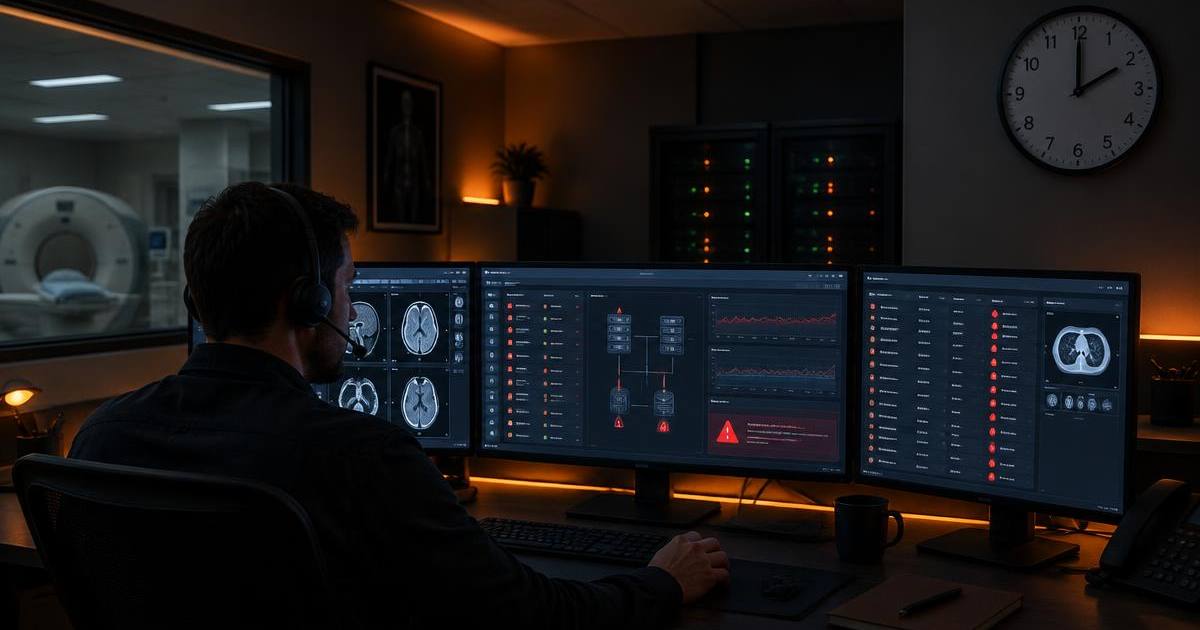
When your PACS goes down at 2 a.m., the quality of your PACS downtime procedures decides how the next few hours unfold. The overnight CT tech cannot push images, the ED is waiting, and whoever is on call is trying to work out whether this is a workstation glitch or a full PACS outage.
Below is a staged timeline of what typically happens during an overnight outage, hour by hour, with real cost figures from published research and a look at where documented procedures change the result.
Why Overnight PACS Outages Are So Expensive
Downtime is costly at any hour. A 2025 analysis from Censinet puts the average cost of healthcare downtime at about $7,500 per minute, rising to roughly $1.7 million per hour for medium-sized hospitals and up to $3.2 million per hour for large ones.
Imaging carries a specific share of that. Research by Basu and Jackson (cited by AuntMinnie), found that imaging system outages at a medium-sized, 200-bed facility cost an average of $94,000 per downtime event, ranging from $55,415 to $132,716 depending on duration. Their findings show that imaging generates approximately $189.54 per bed per hour and accounts for up to 37% of hospital system revenue.
Uptime numbers can hide the exposure. Industry analysis published by AuntMinnie highlights that 99% uptime still permits nearly 7 hours of downtime per month or 87 hours annually. During these outages, staff productivity drops by approximately 20%, erasing the standard efficiency gains PACS provides.
The Overnight PACS Outage, Stage by Stage
1. Hour 0: Detection (2:00–2:10 a.m.)
The first signal is usually a user, not an alarm: a technologist whose studies will not send, or an ED physician whose viewer hangs. Without active monitoring, minutes pass before anyone realizes the problem is bigger than one workstation.
With 24/7 monitoring, an alert on storage, services, or interface queues can arrive before the first phone call. That head start is often the difference between a short incident and a long one.
2. Hour 0: Scoping and Severity (2:10–2:25 a.m.)
The on-call responder needs three critical answers immediately:
- How many users are affected?
- Which sites and modalities are impacted?
- Are modalities still actively acquiring images?
These answers determine the incident severity level and direct the immediate response strategy. A structured severity model, like the one described in the PACS support framework, removes guesswork about how fast the response must be.
3. Hour 1: Escalation (2:25–3:00 a.m.)
This is where many outages stall. The responder may need the PACS vendor, the storage vendor, the network team, and hospital IT, each with a different contact path and entitlement. When those paths live in one person's head, escalation waits until that person answers the phone.
4. Hour 1: Clinical Workarounds (in parallel)
While technical teams work, radiology activates its workarounds: modalities store studies locally or queue them at a gateway, urgent images are viewed at the modality console or a backup viewer, and staff keep a manual log of accession numbers. Our PACS outage runbook checklist covers these steps in more detail.
5. Hour 2+: Restoration
The fix might be restarting a failed service, freeing storage, rolling back a patch, or failing over to a secondary system. Restoration is not complete when the application loads. Queued studies must be forwarded, interfaces confirmed, and the backlog reconciled against the manual log.
6. Next Business Day: Post-Incident Review
A good review reconstructs the timeline, names the root cause, measures each escalation step, and assigns specific prevention actions. Without it, the same outage tends to return on another overnight shift.
Summary Table: Ad Hoc Response vs. Documented Downtime Procedure
| Stage | Ad hoc response | With documented PACS downtime procedures |
|---|---|---|
| Detection | First user complaint | Monitoring alert, often before users notice |
| Scoping | Guesswork by whoever answers | Defined questions mapped to a severity level |
| Escalation | Phone tree dependent on one person | Documented vendor paths and entitlements |
| Clinical workarounds | Improvised per site | Pre-approved steps by study type and site |
| Restoration | Ends when the viewer loads | Ends when backlog and interfaces are verified |
| Review | Often skipped | Written root cause and prevention actions |
How a Documented Downtime Procedure Changes the Night
A written procedure does not prevent every outage, but it compresses each stage above. Responders know which questions to ask, which vendor to call, and which workaround applies. Many hospitals pair that procedure with a team that owns it around the clock, which is the core of managed PACS services: 24/7 monitoring, defined severity commitments, runbooks, and one accountable owner coordinating vendors.
If your environment spans several PACS platforms or sites, it helps to map every system and escalation path before the next overnight incident, not during it. A vendor-agnostic support model keeps that documentation current across platforms.
RAD365 is an operations and workflow partner providing PACS Support and the Radiology Workflow Manager only. RAD365 supports PACS infrastructure and workflow operations.
Be Ready Before the Next 2 A.M. Alert
24/7 monitoring, defined severity response, and documented runbooks from one accountable team.
Explore Managed PACS Services →Frequently Asked Questions
PACS Downtime Procedures
What are PACS downtime procedures?
PACS downtime procedures are a documented, pre-approved set of steps an imaging department follows when PACS becomes unavailable. They cover who detects and declares the outage, who gets called, how modalities keep acquiring images, how urgent studies reach the right clinicians, and how the backlog is reconciled once the system returns.
Who should own PACS downtime procedures in a hospital?
Ownership is usually shared. Radiology leadership owns the clinical workarounds, hospital IT or the PACS support team owns detection, escalation, and restoration, and both sign off on the written procedure so nobody improvises at 2 a.m.
How often should PACS downtime procedures be tested?
At least annually, and after any major upgrade, migration, or change in support provider. A tabletop walkthrough of an overnight outage scenario is the minimum; a scheduled failover or disaster-recovery test is better.
What belongs in a PACS downtime kit at the modality?
Printed contact and escalation lists, instructions for storing studies locally on the modality or a gateway, a manual log for accession numbers and patient identifiers, and the steps for forwarding studies once PACS returns.
When the PACS System Is Down
What should you check first when PACS is down?
Confirm the scope first: is it one workstation, one site, or every user? Then check network connectivity, the PACS application and database services, storage availability, and recent changes. Scope determines severity and who needs to be called.
What is the difference between PACS being down and PACS being slow?
A total PACS outage completely prevents users from storing or retrieving images. A degraded or slow PACS remains functional but suffers from severe load delays and routing latency. Because performance degradation often precedes a complete system failure, both scenarios require defined severity levels and response SLAs.
Can modalities keep scanning when PACS goes down?
Usually yes. Most modalities can store studies locally for a period, and many environments use a DICOM gateway or router that queues studies. The limit is local storage capacity, which is why outage duration matters.
How do urgent overnight studies reach clinicians during a PACS outage?
Through the workaround defined in the downtime procedure, such as viewing images directly at the modality console, a backup viewer, or a secondary archive. The procedure should name which option applies to which study type.
Cost and Frequency of PACS Outages
How much does PACS downtime cost a hospital?
Estimates vary by facility size. Censinet reports healthcare downtime costs hospitals about $7,500 per minute on average, and research by Basu and Jackson cited by AuntMinnie estimates imaging-system outages alone cost a medium-sized facility over $94,000 per event.
How much downtime does 99% PACS uptime actually allow?
Roughly 7 hours per month, or about 87 hours per year, according to industry analysis published by AuntMinnie. That is why uptime percentages alone do not describe how well an outage will be handled.
Why do PACS outages seem to happen overnight?
Overnight windows are when patches, backups, and maintenance jobs often run, and when staffing is thinnest. An issue that starts at 2 a.m. can go unnoticed longer without active monitoring, which lengthens the outage.
Does a vendor-specific outage, such as a Sectra PACS outage, need a different response?
The core incident management workflow remains identical across platforms: detect, scope, escalate, execute workarounds, restore, and review. However, specific escalation paths, vendor entitlements, and technical contacts vary (e.g., Sectra vs. Change Healthcare or GE PACS). A vendor-agnostic support team maintains up-to-date runbooks for every platform in your facility.
Preventing and Recovering From Outages
What does a post-incident review cover after a PACS outage?
Timeline from first alert to full restoration, root cause, how long each escalation step took, whether the downtime procedure was followed, which studies were delayed, and specific actions to prevent a repeat.
How is the study backlog reconciled after PACS comes back?
Studies stored locally on modalities or queued at a gateway are forwarded to PACS, then counted against the manual downtime log so no study is missing, duplicated, or attached to the wrong patient.
Does outpatient imaging need its own PACS downtime procedure?
Yes. Outpatient imaging centers often have fewer on-site IT staff and different hours, so their procedure should specify remote escalation contacts and when to reschedule or divert patients.
How does managed PACS support change what happens during an overnight outage?
It replaces an ad hoc phone tree with 24/7 monitoring, defined severity levels with response commitments, documented runbooks, and one accountable team coordinating vendors until service is restored and reviewed.
Related Services and image access
- Round-the-clock managed PACS operations
- How severity levels and response times work
- Short-term PACS coverage when you need it fast
- PACS is down: what to check first
- A step-by-step PACS outage runbook
Sources
- Censinet, Healthcare Downtime Costs Hospitals: Average Study (2025)
- AuntMinnie, The true cost of downtime in radiology (Basu and Jackson)
- AuntMinnie, Deadly downtime in PACS, and how to avoid it
